
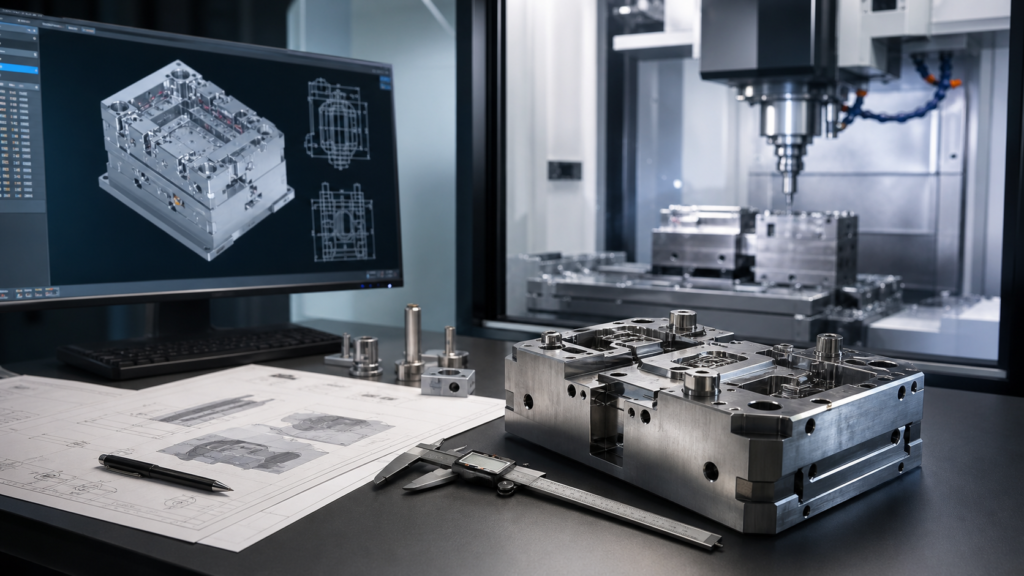
Mold design matters in plastic injection molding because it directly affects part quality, production efficiency, mold life, and total manufacturing cost. A well-designed mold helps plastic flow evenly, cool efficiently, eject smoothly, and maintain stable dimensions during mass production.
Further Reading
For neutral technical background, see injection molding background.
For plastic parts with tight tolerances, cosmetic surfaces, complex geometry, or high-volume production requirements, mold design is not just a technical step. It is the foundation of reliable manufacturing.
What Is Injection Mold Design?
Injection mold design is the process of planning the mold structure used to form a plastic part. It includes cavity and core layout, parting line design, gate location, runner system, cooling channels, venting, ejector system, mold steel selection, and machining strategy.
A good mold design connects product design with real production. It helps turn a 3D part model into a mold that can produce consistent plastic parts at the required quality level.
Key Elements of a Good Mold Design
1. Design for Manufacturability
Design for Manufacturability, often called DFM, helps identify problems before mold production begins. During DFM review, engineers check wall thickness, draft angle, rib design, undercuts, sharp corners, parting lines, and possible shrinkage issues.
Early DFM feedback can reduce mold modifications and prevent expensive production problems.
2. Gate Location
The gate controls where molten plastic enters the mold cavity. Poor gate location can cause weld lines, flow marks, air traps, uneven filling, or cosmetic defects.
The correct gate type and position depend on part shape, resin flow, appearance requirements, and mechanical strength needs.
3. Cooling System
Cooling design has a major effect on cycle time and part stability. Uneven cooling can lead to warping, shrinkage differences, and dimensional variation.
A well-designed cooling system helps shorten production cycles while keeping the plastic part accurate and stable.
4. Venting
Vents allow trapped air and gas to escape during injection. Without proper venting, parts may show burn marks, short shots, weak weld lines, or incomplete filling.
Good venting is especially important for thin-wall parts, complex cavities, and high-speed injection molding.
5. Ejection System
The ejection system removes the molded part from the mold after cooling. Poor ejection design can cause deformation, stress marks, scratches, or stuck parts.
Ejector pins, stripper plates, lifters, and slides must be designed according to part geometry and surface requirements.
How Mold Design Affects Product Quality
Mold design affects many common plastic part quality issues, including warping, sink marks, flash, weld lines, short shots, surface defects, and unstable dimensions. Many of these problems can be reduced before production by improving the mold structure.
When mold design is done correctly, the molding process becomes more stable, and less time is needed for troubleshooting during trial and mass production.
FAQ
What is the most important part of injection mold design?
The most important part is balancing plastic flow, cooling, venting, and ejection. These elements work together to control part quality and production stability.
Why is DFM important before making a mold?
DFM helps detect design risks before machining starts. It can prevent mold revisions, reduce tooling cost, and improve the final plastic part.
Can poor mold design cause warping?
Yes. Poor cooling design, uneven wall thickness, bad gate location, and unbalanced filling can all cause warping in plastic injection molded parts.
Does mold design affect cycle time?
Yes. Cooling channels, runner design, gate design, and ejection efficiency can all affect the molding cycle time and production cost.
Conclusion
Injection mold design is one of the most important factors in plastic part manufacturing. Good mold design improves part quality, reduces defects, shortens cycle time, and supports stable long-term production.
Build Mold supports plastic part projects with mold design review, DFM analysis, precision mold manufacturing, and production-focused engineering solutions.