
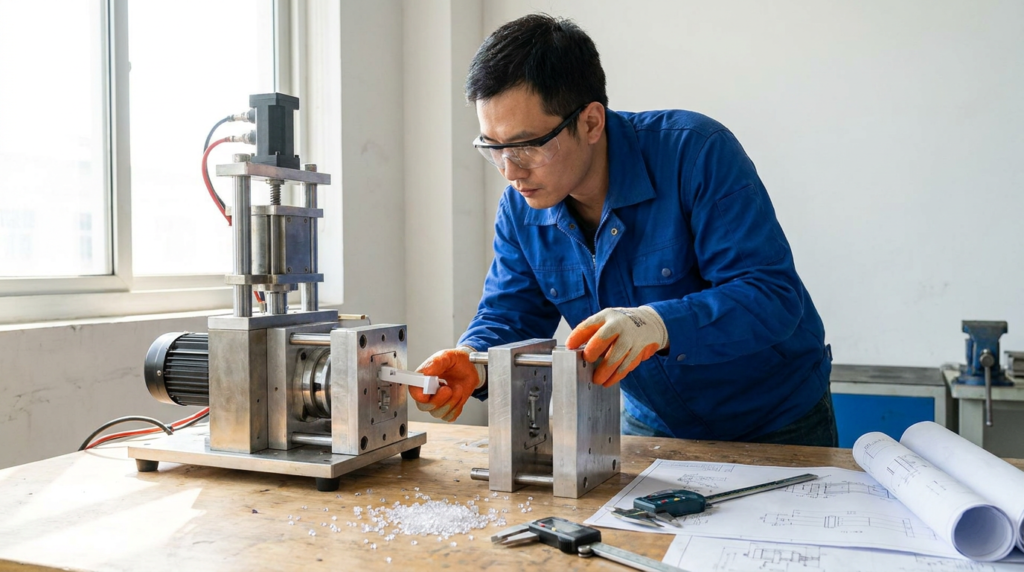
What Is DIY Injection Molding?
DIY injection molding refers to small-scale, low-volume plastic part production carried out outside of a professional factory setting. It typically involves:
Further Reading
For neutral technical background, see injection molding background.
- A desktop or benchtop injection molding machine (manual or semi-automatic)
- A low-cost aluminum or 3D-printed mold
- Commodity thermoplastics such as HDPE, PP, ABS, or PETG
- Annual production volumes typically under 1,000–5,000 parts
DIY molding is popular among inventors, Etsy sellers, small product studios, and engineering students who want to prototype or produce short runs without paying for industrial tooling.
What Equipment Do You Need for DIY Injection Molding?
1. The Injection Molding Machine
Entry-level manual machines start at around $300–$800. Semi-automatic benchtop machines with electric heating range from $1,500 to $6,000.
2. The Mold
- 3D-printed resin molds: $20–$200, suitable for soft plastics and very low volumes (10–50 shots)
- Aluminum soft tooling: $500–$3,000, good for 1,000–10,000 shots
- Professional steel tooling: $5,000–$50,000+, designed for 100,000–1,000,000+ shots
3. Raw Materials
Pelletized thermoplastics are generally sold in 25 kg bags. Expect to pay $2–$8/kg for common materials like ABS, PP, or PE.
4. Safety Equipment
Injection molding involves molten plastic at 180–280°C. Heat-resistant gloves, eye protection, and adequate ventilation are mandatory.
Can You Make Professional-Grade Parts at Home?
| Criteria | DIY / Desktop Molding | Professional Factory Molding |
|---|---|---|
| Dimensional Tolerance | ±0.5 mm or worse | ±0.05 mm (ISO IT7 standard) |
| Surface Finish | Rough, visible parting lines | SPI A1–D3 finishes available |
| Material Compatibility | Limited to low-melt-point plastics | PC, Nylon, POM, TPE, LCP and more |
| Cycle Speed | Manual: 2–5 min/shot | Automated: 10–60 sec/shot |
| Clamp Tonnage | 1–5 tons | 50–3,000+ tons |
| Initial Cost | $500–$6,000 | $10,000–$100,000+ |
Step-by-Step: How to Do DIY Injection Molding
Step 1 — Design Your Part
Use CAD software (Fusion 360, SolidWorks, or FreeCAD). Maintain uniform wall thickness (1.5–3 mm), add 1–3° draft angles, and avoid undercuts.
Step 2 — Create or Source a Mold
For low-volume DIY use, 3D-printed molds in high-temperature resin are cost-effective. For more durability, have a simple aluminum mold machined by a local CNC shop.
Step 3 — Choose Your Material
PP is flexible and chemical-resistant; ABS gives a harder, more rigid part; PE is great for containers and outdoor use.
Step 4 — Set Machine Parameters
Configure melt temperature, injection speed, hold pressure, and cooling time. Each of the four stages of injection molding (filling, packing, cooling, ejection) has specific parameter requirements.
Step 5 — Run Test Shots
The first 5–10 shots are almost always defective. Adjust parameters incrementally and document every change.
Step 6 — Inspect and Trim
Remove gate vestige, trim flash if any, and inspect dimensions with calipers.
Common DIY Injection Molding Problems and Solutions
Short Shots (Incomplete Fill)
Cause: Insufficient injection pressure or too-low melt temperature.
Fix: Increase melt temp by 5–10°C; increase injection speed or pressure.
Flash (Excess Plastic at Parting Line)
Cause: Mold not clamped tightly enough.
Fix: Increase clamp force; reduce injection pressure.
Sink Marks
Cause: Thick sections cooling unevenly.
Fix: Extend hold/packing time; reduce wall thickness.
Warping
Cause: Uneven cooling or residual stress.
Fix: Ensure uniform cooling; reduce packing pressure.
When Should You Move from DIY to Professional Injection Molding?
- You need more than 500–1,000 parts consistently
- Your part requires engineering-grade materials (Nylon, PC, POM)
- The part is a safety-critical or regulated product
- Dimensional tolerances are tighter than ±0.2 mm
Frequently Asked Questions
Is home injection molding safe?
Yes, with proper precautions. Always wear heat-resistant gloves, use eye protection, and ensure adequate ventilation.
How much does DIY injection molding cost to start?
A basic starter setup typically costs $1,500–$5,000. 3D-printed molds can reduce tooling costs to under $200.
What plastics can you use in a DIY injection molder?
Most desktop machines support: LDPE, HDPE, PP, ABS, PETG, and PS.
How many parts can a DIY mold produce?
3D-printed resin molds last 10–100 shots. Aluminum DIY molds handle 1,000–10,000 shots.
What is the difference between DIY injection molding and 3D printing?
3D printing is ideal for complex geometry without tooling cost. Injection molding gives superior surface finish and material properties. For production volumes above a few hundred parts, injection molding becomes more cost-effective.
Summary
DIY injection molding is a genuinely viable option for hobbyists, inventors, and early-stage startups. As volumes increase or tolerances tighten, transitioning to professional mold tooling is the natural next step.