
📌 Key Takeaways
- Cold runner molds cost 30–50% less to build but generate plastic runner waste every cycle — the economics reverse at volumes above 200,000–500,000 parts
- Hot runner systems eliminate runner waste entirely and reduce cycle time by 15–30% by removing the runner cooling requirement
- Valve gate hot runners produce gate vestiges under 0.3mm — effectively invisible on most cosmetic surfaces
- Color changes are significantly faster with cold runners: purge one color and run — hot runners require full manifold flushing which can take hours
- High-cavitation molds (8+) almost always justify hot runners due to balanced fill, zero waste, and cycle time savings
The feed system — how molten plastic gets from the injection machine nozzle to the part cavity — is one of the most impactful design decisions in injection mold engineering. The choice between a cold runner and a hot runner system affects tooling cost, material waste, cycle time, gate aesthetics, and operational complexity. This guide provides a clear technical comparison to help engineers and buyers make the right decision for their application.
Further Reading
For neutral technical background, see injection molding background.
1. How Cold Runner Systems Work
In a cold runner mold, the channels that deliver plastic from the machine nozzle to the gate are machined into the mold parting surface and cooled along with the part. Each cycle produces a solid plastic runner skeleton that must be removed, degated, and either recycled (reground) or discarded.
- Two-plate mold — The runner is machined on the parting line and ejected with the part. Simple design, lowest tooling cost, but requires manual or automated degating.
- Three-plate mold — A separate runner plate automatically separates the runner from the parts during mold opening, enabling pin-point gating with auto-degating without a hot runner system.
- Runner size — Round runners (most efficient) are sized to balance fill across all cavities. Typical diameter: 4–10mm depending on material viscosity and flow length.
- Regrind considerations — Runner regrind degrades material properties with each pass. For engineering grades (PC, PA+GF), regrind content should not exceed 20–30%.
2. How Hot Runner Systems Work
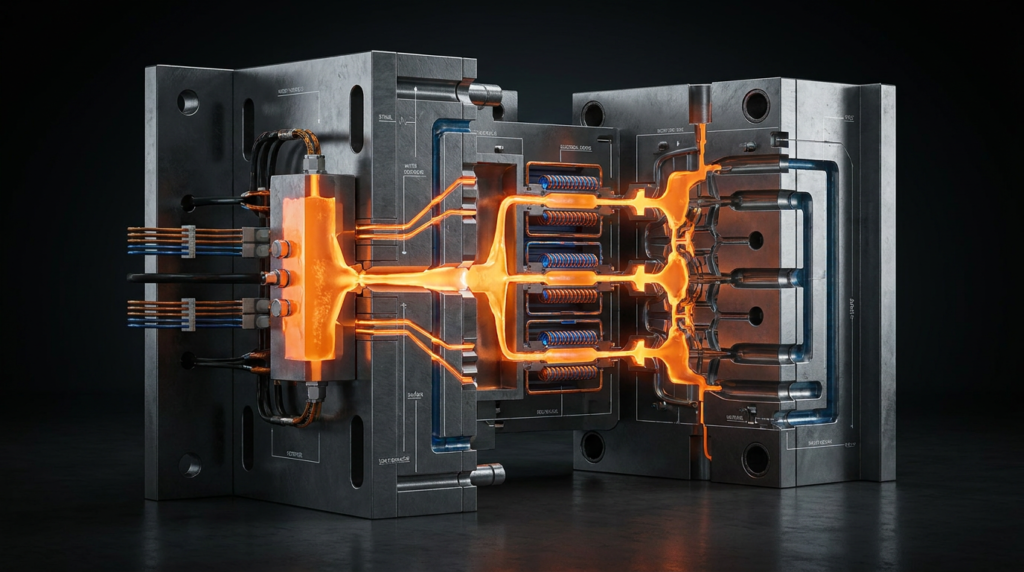
Hot runner systems use electrically heated manifolds and nozzles to keep the plastic in a molten state at all times. Only the part is cooled and ejected — there is no runner to remove or recycle.
- Heated manifold — The main distribution plate, heated to the material’s processing temperature. Must maintain temperature uniformity within ±2°C to prevent color streaks and material degradation.
- Open tip nozzles (thermal gating) — The nozzle tip freezes off between cycles. Lower cost, but leaves a small gate nub. Suitable for unfilled amorphous materials.
- Valve gate nozzles — A mechanical pin controlled by pneumatic or hydraulic actuators shuts off the gate orifice, producing a clean, flat gate mark. Essential for cosmetic surfaces and glass-filled materials.
- Manifold balancing — Hot runner manifolds are flow-balanced (equal flow length and diameter to each nozzle) to ensure consistent fill pressure across all cavities.
3. Side-by-Side Comparison
| Factor | Cold Runner | Hot Runner |
|---|---|---|
| Tooling cost | Lower (simpler mold) | Higher (+\,000–\,000 per nozzle) |
| Material waste | Runner waste every cycle | Zero runner waste |
| Cycle time | Longer (runner cooling required) | 15–30% shorter |
| Gate aesthetics | Gate mark on parting line | Minimal vestige (valve gate) |
| Color change | Fast (purge runner) | Slow (flush entire manifold) |
| Maintenance | Simple | Complex (heaters, thermocouples) |
| Best for | Low volume, multi-color, prototypes | High volume, expensive resins, cosmetic parts |
| Minimum viable volume | Any | Typically 200,000+ parts/year |
4. When to Choose Cold Runner
- Low-to-medium production volumes — Below 200,000–500,000 parts per year, the tooling cost premium of a hot runner system cannot be justified by material savings.
- Frequent color or material changes — Cold runners allow rapid color purging. Hot runners require manifold flushing that can consume hundreds of shots of material.
- Budget-constrained tooling — Initial tooling investment is the primary constraint and the production run is limited. Cold runner molds are 30–50% cheaper to build.
- Prototype and development tools — Development molds benefit from the simplicity and low cost of cold runners; hot runner systems can be added in production tooling.
5. When to Choose Hot Runner
- High production volumes — At 1,000,000+ parts per year, material savings from eliminating runner waste alone typically pay back the hot runner investment within 3–6 months.
- Expensive engineering resins — Materials like PEEK, LCP, or PPS at \–\/kg make runner waste economically unacceptable even at moderate volumes.
- Cosmetic surface requirements — Valve gate hot runners place gate marks in controlled, predictable locations with minimal vestige, enabling Class A surfaces impossible with cold runners.
- High cavitation molds — 8+ cavity molds with cold runners require large, complex runner systems that consume significant clamp force. Hot runners eliminate runner weight and reduce required tonnage by 15–25%.
The hot runner vs. cold runner decision is not binary — it is an optimization based on annual volume, material cost, cosmetic requirements, and tooling budget. At BuildMold, our engineers analyze your specific project parameters and recommend the feed system that delivers the best total cost of ownership over the expected production life of the mold.
🔗 Related Articles
Designing a New Mold?
Tell us your annual volume and material, and we will recommend the optimal feed system with a transparent tooling cost breakdown.
Or email us directly: sales@buildmold.com