
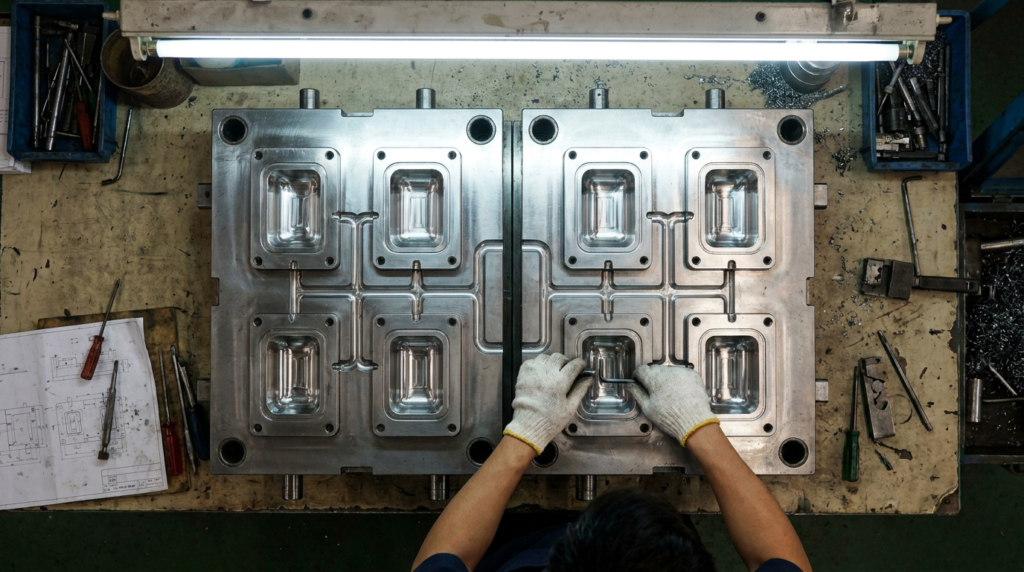
📌 Key Takeaways
- A 4-cavity mold produces 4 parts per cycle — effectively reducing per-part cycle time cost by 75% compared to a single-cavity mold at the same machine hourly rate
- Runner balance is critical in multi-cavity molds: pressure imbalance of just 10% between cavities causes dimensional variation between parts from different cavities
- Steel grade requirements increase with cavity count: high-cavity molds require H13 or better to maintain dimensional stability under repeated thermal cycling
- CMM verification of cavity-to-cavity dimensional consistency is mandatory at T1 — accept no more than 0.02mm variation between corresponding features
- Mold maintenance complexity scales with cavity count: 8-cavity molds require 8× the ejector pin inspection effort of single-cavity tools
Multi-cavity injection molds produce two or more identical parts per machine cycle, dramatically reducing the per-part manufacturing cost at high production volumes. The engineering complexity of a multi-cavity mold, however, is substantially greater than a single-cavity tool — runner balance, cavity consistency, cooling uniformity, and steel grade requirements all scale with cavity count. This guide covers the engineering fundamentals of multi-cavity mold design.
Further Reading
For neutral technical background, see injection molding background.
1. What Is a Multi-Cavity Mold
| Configuration | Cavities | Typical Application | Tooling Cost vs 1-Cavity |
|---|---|---|---|
| Single cavity | 1 | Prototypes, low volume, large complex parts | 1× (baseline) |
| 2-cavity | 2 | Medium volume, moderate complexity | 1.4–1.6× |
| 4-cavity | 4 | High volume, standard complexity | 1.8–2.2× |
| 8-cavity | 8 | Very high volume, simple-medium parts | 2.5–3.5× |
| 16+ cavity | 16–128 | Commodity parts, packaging, caps & closures | 4–8× |
2. Cavity Balance & Runner Design
The most critical engineering challenge in multi-cavity mold design is ensuring that all cavities fill simultaneously, at the same pressure, with the same flow front velocity. Imbalanced fill causes:
- Dimensional variation between cavities — Cavities that fill first are overpacked; cavities that fill last are underpacked, causing systematic dimensional differences
- Flash in early-filling cavities — Overpacking in near-gate cavities causes flash while far-gate cavities are still short-shot
- Weld line position variation — Affects structural and cosmetic consistency across cavities
- Natural (H-tree) balancing — Runner branches split symmetrically, ensuring equal flow length and diameter to every cavity. Effective but wastes material in high-cavity molds
- Melt flipper / mold masters balancing — Proprietary inserts in the runner system that artificially balance melt shear heating, achieving rheological balance without equal flow lengths
3. Steel Grade Requirements
High-cavity molds cycle at higher frequencies (more shots per hour than single-cavity tools producing the same output) and generate greater cumulative thermal stress. Steel selection must account for this:
- 2–4 cavity molds: P20 or 718H acceptable for standard engineering resins at moderate volumes
- 8–16 cavity molds: H13 (48–52 HRC) recommended for core and cavity inserts to resist thermal fatigue from high cycling frequency
- High-cavitation (32+) molds: Premium H13 or S7 (shock-resistant) steel. Cavity inserts often individually replaceable to allow targeted replacement without full mold rebuild
- Surface treatment: PVD coating (TiN, CrN) on high-wear areas (gate, ejector zones) extends service life by 3–5× in high-cycle applications
4. Tolerances & Cavity-to-Cavity Consistency
Each cavity in a multi-cavity mold must produce parts that are dimensionally interchangeable. This requires:
- Cavity machining tolerance: ±0.005mm on critical dimensions, using the same CNC program and datums for all cavities to ensure systematic (not random) dimensional variation
- CMM verification at T1: Measure 5 parts from each cavity. Maximum allowable cavity-to-cavity variation: 0.02mm on critical dimensions; 0.05mm on non-critical
- Insert standardization: All cavity inserts machined from the same steel batch and heat-treated together to ensure identical hardness and dimensional response to thermal cycling
- Cooling uniformity: Each cavity must have its own cooling circuit of equal length and diameter. Shared circuits cause differential temperatures between cavities
5. Cost vs Output Analysis
| Cavity Count | Mold Cost (relative) | Parts per Hour (est.) | Cost per 1M Parts (relative) | Break-even Volume |
|---|---|---|---|---|
| 1 | 1.0× | 900 | 1.0× | Any volume |
| 2 | 1.5× | 1,800 | 0.75× | ~200,000 parts |
| 4 | 2.0× | 3,600 | 0.50× | ~400,000 parts |
| 8 | 3.2× | 7,200 | 0.40× | ~800,000 parts |
| 16 | 5.0× | 14,400 | 0.31× | ~2,000,000 parts |
The break-even volume — where the higher tooling investment of a multi-cavity mold is recovered through lower per-part costs — depends on machine hourly rate, cycle time, and material cost. BuildMold’s engineering team performs a cavity count optimization analysis for every project, recommending the configuration that delivers the lowest total cost of ownership for your production volume.
Optimizing Your Cavity Count?
Share your annual volume and part complexity. We will recommend the optimal cavity configuration with a full cost-benefit analysis.
Or email us directly: sales@buildmold.com