
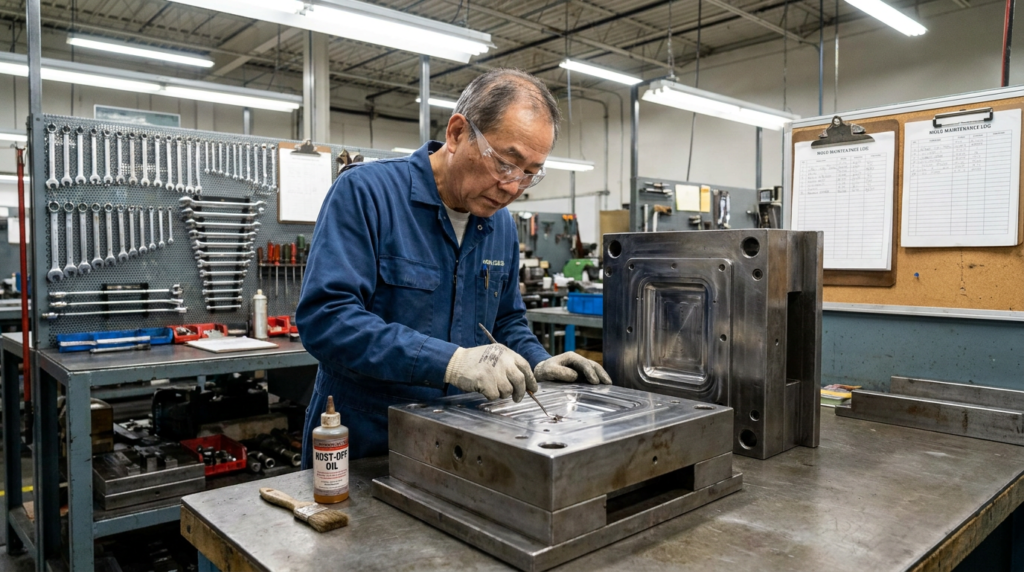
📌 Key Takeaways
- A well-maintained mold can achieve 1,000,000+ shots; a neglected mold may fail at 200,000 shots — maintenance is the cheapest form of mold insurance
- Cooling channels must be descaled every 50,000–100,000 shots — scale buildup of just 0.5mm reduces heat transfer efficiency by up to 40%
- Ejector pins are the most frequently replaced mold component — inspect for bending, galling, and wear every 50,000 shots
- Rust prevention is critical during storage: apply anti-corrosion oil to all steel surfaces and store in a dry environment above 15°C
- Every mold should have a maintenance logbook recording shot count, repairs, part replacements, and dimensional re-verification dates
A precision injection mold is a capital investment that should deliver consistent quality parts for hundreds of thousands — or millions — of cycles. Whether it does depends almost entirely on the quality and consistency of preventive maintenance. Reactive maintenance (fixing problems after they occur) costs 5–10× more than preventive maintenance and causes costly unplanned production downtime. This guide covers a structured preventive maintenance program for injection molds.
Further Reading
For neutral technical background, see injection molding background.
Also see Why Do Injection Molds Fail? for common failure causes such as wear, corrosion, cracking, cooling problems, venting issues, and poor maintenance.
1. Why Mold Maintenance Matters
Injection molds operate under extreme conditions: cyclic thermal stress (heating and cooling every 20–60 seconds), high injection pressures (500–2,000 bar), abrasive plastic materials, and chemical exposure from resin decomposition gases. Without maintenance, these conditions cause:
- Ejector pin seizure — Inadequate lubrication causes pins to gall against the pin bore, leading to stuck parts or broken pins
- Cooling channel scaling — Mineral deposits from hard water reduce cooling efficiency, increasing cycle time and causing hot spots that produce sink marks and warpage
- Cavity corrosion — Condensation during shutdown, combined with acidic decomposition gases from PVC or flame-retardant resins, causes pitting that prints onto part surfaces
- Parting surface damage — Contamination or impact damage creates local high spots that cause flash on every subsequent shot
- Spring fatigue — Return springs lose preload over time, causing incomplete ejector retraction and mold-closure damage
2. Daily & Per-Run Maintenance Checklist
| Task | Frequency | Method |
|---|---|---|
| Clean parting surface | Every run | Wipe with lint-free cloth and isopropyl alcohol; inspect for damage |
| Inspect & clean vents | Every run | Clear with brass brush; measure vent depth if flash appears |
| Lubricate ejector pins | Every 5,000–10,000 shots | Apply mold lubricant (PTFE-based) sparingly to pin shanks |
| Lubricate guide pins & bushings | Every 10,000 shots | Apply high-pressure grease to guide pillars and bushings |
| Inspect water connections | Every run | Check for leaks; verify inlet/outlet temperatures are within 5°C |
| Check ejector return | Every run | Confirm full ejector retraction before mold closes |
| Log shot counter | Every run | Record cumulative shot count in maintenance logbook |
3. Periodic Deep Maintenance
- Every 50,000 shots: Full disassembly inspection. Check ejector pin diameter vs bore clearance (should be 0.01–0.02mm). Inspect slider wear plates. Verify parting surface flatness with engineer’s blue.
- Every 100,000 shots: Chemical descaling of all cooling channels using citric acid solution. Replace all ejector pin return springs. Re-verify critical dimensions with CMM against original inspection report.
- Every 250,000 shots: Full polishing of all cavity and core surfaces to restore original surface finish. Replace worn guide bushings. Check all heater elements (hot runner molds) and replace thermocouples showing drift.
- Every 500,000 shots: Major overhaul. Replace high-wear inserts (gate area, ejector zones). Verify mold base parallelism. Re-harden cavity steel if hardness has dropped below minimum specification.
4. Common Damage & Repair Methods
| Damage Type | Cause | Repair Method |
|---|---|---|
| Surface corrosion / pitting | Condensation, acidic gases | Polish out if shallow; TIG weld repair + re-polish if deep |
| Chipped or cracked cavity edge | Impact, excess ejection force | TIG micro-weld with matching steel filler; re-machine to dimension |
| Worn gate area | High-velocity plastic flow abrasion | Replace gate insert or weld and re-machine gate geometry |
| Galled ejector pin bore | Insufficient lubrication, misalignment | Ream bore to next oversize; replace pin to match |
| Flash on parting surface | Damage or contamination | Stone flat; replace if chipped; check clamp tonnage setting |
5. Mold Storage Best Practices
- Clean before storage — Remove all plastic residue, clean all surfaces, and blow out water channels completely to prevent corrosion from residual moisture
- Apply rust preventive — Coat all steel surfaces (cavity, core, slides, ejector pins) with a dedicated mold corrosion inhibitor. Do not use WD-40 — it evaporates and leaves no lasting protection
- Close and block — Store molds in the closed position. Insert foam or wooden blocks between parting surfaces to prevent accidental closing damage during handling
- Environmental control — Store in a dry environment above 15°C. High humidity accelerates corrosion even on oiled surfaces
- Documentation — Tag every mold with its shot count, last maintenance date, and any known issues before placing in storage
BuildMold ships every mold with a recommended maintenance schedule tailored to the mold’s complexity and the customer’s production volume. We also offer mold refurbishment and repair services for molds produced by any manufacturer.
Need Mold Maintenance Support?
Contact us for mold refurbishment, repair quotations, or a custom preventive maintenance schedule for your tooling.
Or email us directly: sales@buildmold.com