
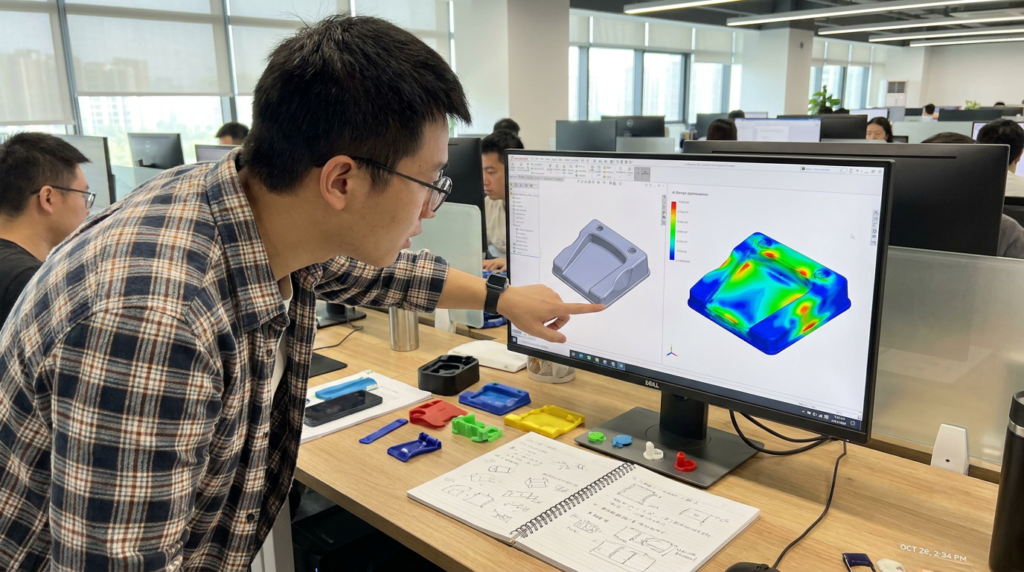
Is AI replacing 3D modeling? This question is increasingly asked by product designers, CAD engineers, mold makers, and manufacturing professionals as AI-powered design tools rapidly mature. The honest answer in 2025 is: AI is transforming 3D modeling — dramatically augmenting human capability — but it is not replacing human designers and engineers. Understanding what AI can and cannot do in 3D design is essential for anyone in product development, injection molding, or manufacturing.
Further Reading
For neutral technical background, see 3D printing background.
What AI Can Do in 3D Modeling Today
1. Generative Design and Topology Optimization
AI-powered generative design tools (Autodesk Fusion 360 Generative Design, nTopology, Altair Inspire) accept engineering constraints — load cases, material, manufacturing process, weight targets — and generate optimized geometries that a human designer would rarely conceive:
- Organic, lattice-like structures that minimize material while meeting structural requirements
- Parts optimized simultaneously for stiffness, weight, and manufacturability
- Multiple design alternatives generated in minutes rather than days
For injection molding specifically, AI generative design tools are now beginning to incorporate DFM constraints — draft angles, uniform wall thickness, ejection direction — into the optimization, producing designs that are both structurally optimized and mouldable.
2. AI-Assisted CAD Modeling
Major CAD platforms are integrating AI assistants that accelerate routine modeling tasks:
- Autodesk AI: Automatic feature recognition, intelligent dimensioning suggestions, and natural language CAD commands in Fusion 360
- SOLIDWORKS AI: Predictive feature suggestions, automatic drawing view creation, and design validation checks
- PTC Creo Generative Design: Real-time simulation-driven design optimization during modeling
- Siemens NX AI: Manufacturing process simulation and automated DFM feedback during design
These tools reduce the time experienced engineers spend on repetitive modeling tasks — but still require human judgment for design intent, functional requirements, and aesthetic decisions.
3. Text-to-3D and Image-to-3D Generation
Emerging AI tools can generate rough 3D models from text descriptions or 2D images:
- Point-E, Shap-E (OpenAI): Text-to-3D mesh generation — experimental, produces conceptual shapes
- Luma AI, Meshy AI: Image-to-3D conversion for product visualization
- NVIDIA GET3D, Magic3D: High-quality 3D asset generation for games and visualization
Current limitation: These tools produce visually plausible 3D meshes suitable for rendering and concept visualization — not engineering-grade models with precise dimensions, tolerances, or manufacturability for injection molding production.
4. Mold Design AI Assistance
AI is beginning to automate elements of injection mold design:
- Automatic parting line detection: AI algorithms identify optimal parting lines and draft directions from the part geometry
- Gate location optimization: AI-assisted mold flow analysis suggests gate positions that minimize weld lines and fill imbalance
- Cooling channel layout generation: AI optimization of cooling circuit paths for uniform temperature distribution
- DFM automated checking: Tools like Boothroyd Dewhurst DFMA and Moldex3D DFM advisor automatically flag non-manufacturable features — undercuts, insufficient draft, thin walls
5. AI in Injection Molding Process Control
AI is having its most immediate impact in injection molding production — not design:
- AI process optimization: Systems like iMFLUX, RJG eDart, and Kistler ComoNeo use machine learning to automatically adjust process parameters in real time, maintaining part quality as conditions change
- Predictive maintenance: AI analyses machine sensor data to predict failures before they cause downtime
- Vision-based quality inspection: AI vision systems inspect 100% of parts at line speed — detecting surface defects, dimensional deviations, and assembly errors
- Digital twin simulation: AI-enhanced mold flow simulations predict process behaviour with increasing accuracy, reducing physical trial iterations
What AI Cannot Do (Yet) in 3D Modeling
Despite rapid advances, significant limitations remain:
- Engineering judgment and design intent: AI cannot understand why a designer made a specific trade-off — balancing aesthetics, function, cost, user experience, regulatory requirements, and manufacturing constraints simultaneously
- Production-ready precision models: Text-to-3D tools produce concept meshes, not parametric engineering models with GD&T, material callouts, and manufacturing specifications
- Novel problem solving: AI excels at optimizing within known solution spaces but struggles with genuinely new design challenges that require creative engineering insight
- Full DFM for injection molding: While AI tools are improving, they cannot yet fully replicate the holistic DFM judgment of an experienced mold designer who considers gating strategy, cooling layout, steel strength, ejection design, and trial risk simultaneously
- Cross-disciplinary integration: Great product design integrates mechanical engineering, user experience, industrial design, manufacturing, and supply chain — a systems-level judgment that AI currently supports but does not replace
How AI Is Changing the 3D Modeling Profession
Rather than eliminating 3D modeling roles, AI is reshaping what skilled designers and engineers spend their time on:
| Task | Before AI | With AI |
|---|---|---|
| Topology optimization | Hours/days of manual iteration | Minutes — AI generates candidates |
| DFM checking | Manual review against checklist | Automated — AI flags issues instantly |
| Drawing creation | Hours of manual dimensioning | AI drafts; engineer reviews and approves |
| Mold flow simulation | Engineer sets up and interprets | AI assists setup; engineer interprets results |
| Concept modeling | CAD modeling from scratch | AI generates starting geometry; engineer refines |
| Process parameter setting | Trial and error or DOE | AI optimizes in real time during production |
The net effect is that AI makes skilled designers and engineers more productive — enabling them to explore more design alternatives, catch problems earlier, and spend more time on high-value creative and engineering judgment work.
The Future: AI + Human Collaboration in Manufacturing Design
The trajectory of AI in 3D modeling and injection molding design points toward increasingly powerful human-AI collaboration:
- 2025–2027: AI DFM advisors become standard in all major CAD platforms; AI-assisted mold design tools automate parting line, gating, and cooling layout generation as starting points for engineer review
- 2027–2030: Multimodal AI (combining vision, language, and engineering simulation) enables conversational design — engineers describe requirements in natural language, AI generates candidate designs with full DFM compliance
- 2030+: AI-human co-design becomes the norm — AI handles optimization, DFM checking, and simulation while human engineers focus on requirements definition, trade-off decisions, and innovation
Frequently Asked Questions
Is AI replacing 3D modeling?
AI is transforming 3D modeling by automating repetitive tasks, enabling generative design, and accelerating DFM analysis — but it is not replacing human 3D modelers and engineers. Production-ready engineering models still require human judgment for design intent, functional trade-offs, manufacturing specifications, and regulatory compliance. AI augments skilled designers; it does not yet replace them.
Can AI generate injection mold designs automatically?
AI can automate specific elements of mold design — parting line suggestion, draft angle checking, cooling channel optimization, and gate location recommendation — but full mold design still requires experienced tooling engineers to make integrated decisions about steel selection, ejection system design, side action strategy, and trial risk management that AI cannot yet handle holistically.
What AI tools are used in injection molding?
Key AI tools in injection molding include: Autodesk Moldflow and Moldex3D (AI-enhanced mold flow simulation), iMFLUX (AI process control), RJG eDart (real-time process monitoring with machine learning), Kistler ComoNeo (in-cavity pressure-based quality assurance), and vision-based AI inspection systems from Cognex, Keyence, and others. On the design side, Autodesk Fusion 360 Generative Design and Siemens NX AI offer AI-assisted design optimization.
Will AI make injection molding engineers obsolete?
No — AI will make injection molding engineers more productive and valuable, not obsolete. The engineers who embrace AI tools will be able to design better products faster, run fewer trial iterations, and manage more complex projects. The engineers who resist AI tools risk being outcompeted by AI-augmented colleagues, not by AI itself.
How is AI improving injection molding quality?
AI improves injection molding quality through: (1) real-time process adjustment systems that maintain part quality as machine, material, and environmental conditions change; (2) 100% vision-based inspection that catches defects at line speed without sampling; (3) predictive maintenance that prevents machine failures before they cause quality events; and (4) digital twin simulations that predict and prevent defects before production begins.
Summary
AI is not replacing 3D modeling or injection molding engineering — it is transforming both disciplines by automating routine tasks, enabling generative optimization, accelerating DFM analysis, and improving process control. The 3D modeling and injection molding professionals who will thrive are those who learn to work with AI tools as powerful collaborators — using AI to handle optimization and analysis while applying their own engineering judgment, creativity, and domain expertise to the decisions AI cannot yet make. The future of injection molding design is human-AI collaboration, not human replacement.