
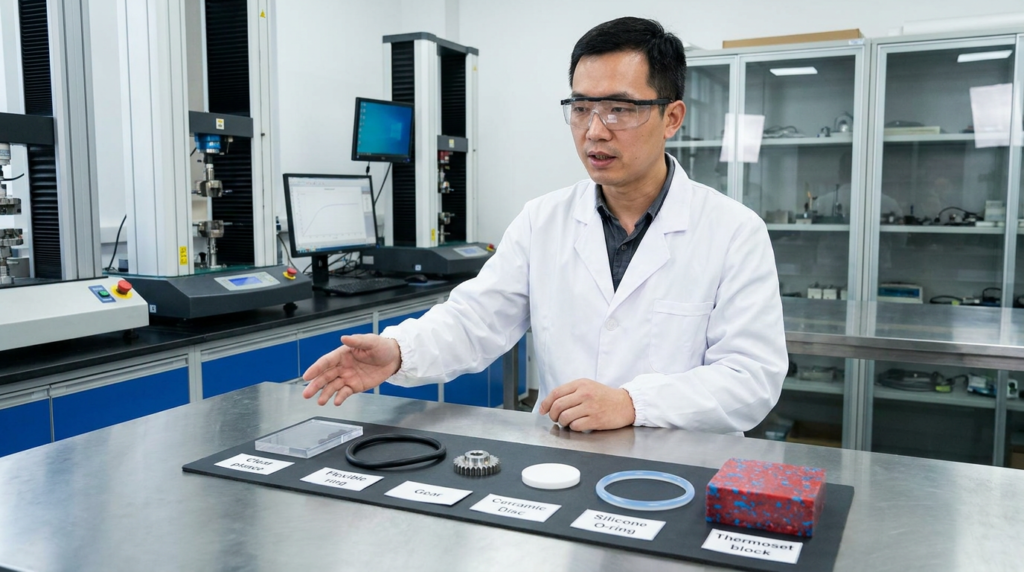
When most people think of injection moulding, they think of plastic. But is injection molding only plastic? The answer is no — injection moulding as a process principle (forcing material into a closed mould under pressure) is applied to a much broader range of materials than thermoplastics alone. Metals, rubber, ceramics, and silicone can all be processed through injection-based techniques, each with its own equipment, process conditions, and applications.
Further Reading
For neutral technical background, see injection molding background.
This guide explores the full range of materials processed by injection moulding and related injection-based processes.
What Materials Can Be Injection Moulded?
| Material Category | Process Name | Examples | Key Applications |
|---|---|---|---|
| Thermoplastics | Injection Moulding (IM) | ABS, PP, PC, Nylon, POM, PET | Consumer products, automotive, medical, packaging |
| Thermosets | Thermoset Injection Moulding / RIM | Epoxy, phenolic, melamine, BMC | Electrical components, structural parts, automotive |
| Rubber / Elastomers | Rubber Injection Moulding | NR, SBR, EPDM, silicone rubber | Seals, gaskets, O-rings, vibration dampeners |
| Liquid Silicone (LSR) | Liquid Silicone Rubber Injection (LSR) | Medical-grade silicone, food-grade silicone | Baby products, medical devices, wearables |
| Metals | Metal Injection Moulding (MIM) | Stainless steel, titanium, copper alloys, tungsten | Surgical instruments, firearms, dental, aerospace |
| Ceramics | Ceramic Injection Moulding (CIM) | Alumina, zirconia, silicon nitride | Electronics, cutting tools, dental crowns, sensors |
Thermoplastic Injection Moulding (Standard)
The most common form — thermoplastic injection moulding accounts for the vast majority of injection-moulded parts globally. Over 18,000 grades of thermoplastic material are commercially available, ranging from commodity resins (PP, PE, PS) to high-performance engineering polymers (PEEK, PEI, LCP).
Key characteristics:
- Material melts under heat, solidifies on cooling — fully reversible (recyclable)
- Processing temperatures: 150°C–400°C depending on resin
- Cycle times: 10 seconds to several minutes
- Mould material: steel or aluminium
Thermoset Injection Moulding
Thermosets are plastics that undergo irreversible chemical curing when heated — they cannot be re-melted. Thermoset injection moulding (also called transfer moulding or thermoset injection moulding) injects a pre-heated thermoset compound into a heated mould where it cures permanently.
- Materials: Phenolic (Bakelite), epoxy, melamine, BMC (Bulk Moulding Compound), DMC (Dough Moulding Compound)
- Process temperature: 150–200°C (mould is heated, not cooled)
- Cycle time: Longer than thermoplastics — 30 seconds to 3 minutes for curing
- Applications: Electrical switches and insulators, automotive under-hood components, circuit breaker housings
- Advantage: Excellent heat resistance, dimensional stability, and electrical insulation properties — outperforming thermoplastics in high-temperature environments
Rubber Injection Moulding
Rubber injection moulding processes uncured rubber compound (natural or synthetic elastomer) through an injection moulding machine into a heated mould where vulcanisation (curing) occurs. It is significantly faster and more consistent than compression moulding for rubber parts.
- Materials: Natural rubber (NR), EPDM, SBR, NBR, neoprene, silicone rubber (solid)
- Process: Rubber compound is plasticised at low temperature in the barrel, injected into a heated mould (150–200°C) where it vulcanises
- Applications: O-rings, gaskets, seals, vibration isolation mounts, automotive weatherstripping, footwear soles
- Advantage over compression moulding: Shorter cycle time, better dimensional consistency, lower flash, suitable for automation
Liquid Silicone Rubber (LSR) Injection Moulding
LSR moulding is one of the fastest-growing injection-based processes, particularly in medical, food contact, and wearable technology applications. Liquid silicone rubber is a two-component platinum-catalysed silicone that is pumped in precisely metered ratios into a cooled injection unit and injected into a heated mould where rapid curing occurs.
- Material: Two-part platinum-cured silicone (Part A + Part B mixed at 1:1 ratio)
- Process: Components kept cold in injection unit (to prevent premature cure), mould heated to 150–220°C for rapid vulcanisation
- Cycle time: 15–60 seconds — surprisingly fast for a thermoset process
- Applications: Baby bottle nipples, medical device seals and valves, wearable device skin contacts, food processing equipment seals, automotive gaskets
- Key properties: Biocompatible, withstands sterilisation, temperature range −60°C to +200°C, excellent transparency available
Metal Injection Moulding (MIM)
Metal injection moulding (MIM) is one of the most remarkable non-plastic injection moulding processes — producing complex, near-net-shape metal components that would be difficult or impossible to machine from solid stock. MIM parts are indistinguishable from machined metal in final properties.
The MIM Process
- Feedstock preparation: Fine metal powder (particle size <20 μm) is mixed with a thermoplastic and wax binder to create a mouldable feedstock
- Injection moulding: Feedstock is injection moulded like plastic — forming a “green part” that has the shape but not yet the properties of metal
- Debinding: The binder is removed by thermal, solvent, or catalytic debinding — leaving a porous “brown part”
- Sintering: The brown part is heated to near the metal’s melting point in a controlled atmosphere furnace — the metal particles fuse, the part shrinks uniformly (~15–20%) and reaches near-full density
MIM Materials and Applications
| Material | Typical Application |
|---|---|
| 316L Stainless Steel | Surgical instruments, orthodontic brackets, watch components |
| 17-4 PH Stainless Steel | Firearms components, aerospace fittings |
| Titanium (Ti-6Al-4V) | Medical implants, dental components, aerospace |
| Tungsten alloys | Radiation shielding, military, counterweights |
| Copper alloys | Electrical connectors, heat sinks |
| Tool steel (M2, H13) | Cutting tools, mould components |
MIM Advantages
- Complex geometries impossible or uneconomical to machine
- Near-net-shape — minimal post-processing required
- Excellent surface finish (Ra 0.8–1.6 μm as-sintered)
- Full mechanical properties equivalent to wrought metal
- Cost-effective for high volumes of small, complex parts (typically <100g)
Ceramic Injection Moulding (CIM)
Ceramic injection moulding (CIM) follows the same process principle as MIM — ceramic powder is mixed with a binder, injection moulded, debound, and sintered. The result is a dense, fully ceramic component with the geometric complexity achievable only through injection moulding.
- Materials: Alumina (Al₂O₃), zirconia (ZrO₂), silicon nitride (Si₃N₄), hydroxyapatite
- Applications: Ceramic cutting inserts, dental crowns and bridges, electronic substrates, sensor housings, medical implants, watch bezels (luxury timepieces)
- Key properties: Extreme hardness, wear resistance, chemical inertness, biocompatibility, high-temperature stability
Frequently Asked Questions
Is injection molding only for plastic?
No. While thermoplastic injection moulding is by far the most common application, injection-based processes are also used for rubber, liquid silicone rubber (LSR), thermosets, metals (MIM), and ceramics (CIM). Each uses the same fundamental principle — injecting material into a closed mould under pressure — but with different equipment, temperatures, and post-processing steps.
Can you injection mold metal?
Yes — through Metal Injection Moulding (MIM). Fine metal powder is mixed with a thermoplastic binder, injection moulded into shape, the binder is removed, and the part is sintered to achieve full metal density and properties. MIM is widely used for small, complex stainless steel, titanium, and tungsten components in medical, aerospace, and consumer applications.
What is LSR injection moulding?
LSR (Liquid Silicone Rubber) injection moulding processes a two-part platinum-cured silicone through a specially cooled injection unit into a heated mould where rapid vulcanisation occurs. It produces soft, flexible, biocompatible silicone parts — widely used for baby products, medical device seals, and wearable technology components.
Can rubber be injection moulded?
Yes — rubber injection moulding processes uncured rubber compound through an injection machine into a heated mould where vulcanisation (curing) occurs. It offers significant advantages over compression moulding for rubber parts: shorter cycle time, better dimensional consistency, lower flash, and suitability for automation. Common applications include O-rings, gaskets, seals, and automotive weatherstripping.
What is the difference between plastic injection moulding and metal injection moulding?
In plastic injection moulding, thermoplastic resin is melted and injected into a mould — the part is complete when cooled. In MIM, metal powder mixed with a binder is injection moulded, then goes through two additional steps: debinding (binder removal) and sintering (high-temperature densification). MIM parts shrink ~15–20% during sintering but achieve near-full metal density and mechanical properties equivalent to machined metal.
Is ceramic injection moulding widely used?
CIM is used for specialised, high-value applications where ceramic’s unique properties (extreme hardness, wear resistance, biocompatibility, chemical inertness) justify the process complexity and cost. It is growing in dental, medical implant, luxury watch, and cutting tool markets where CIM enables complex geometries that cannot be achieved by traditional ceramic pressing and sintering routes.
Summary
Injection moulding is far more than a plastic-only process. From thermoplastics and thermosets to rubber, liquid silicone, metals, and ceramics, the injection moulding principle is applied across an extraordinary range of materials — each enabling unique combinations of geometry, performance, and production efficiency that alternative processes cannot match.
Understanding the breadth of injection-based manufacturing processes is essential for engineers and buyers selecting the right material-process combination for demanding applications — whether that is a flexible silicone medical seal, a complex stainless steel surgical instrument, or a precision ceramic dental crown.