
📌 Key Takeaways
- Mold flow simulation can predict short shots, weld line locations, sink marks, and warpage before a single kilogram of steel is purchased — corrections at the design stage cost hours; after mold build, they cost weeks and thousands of dollars
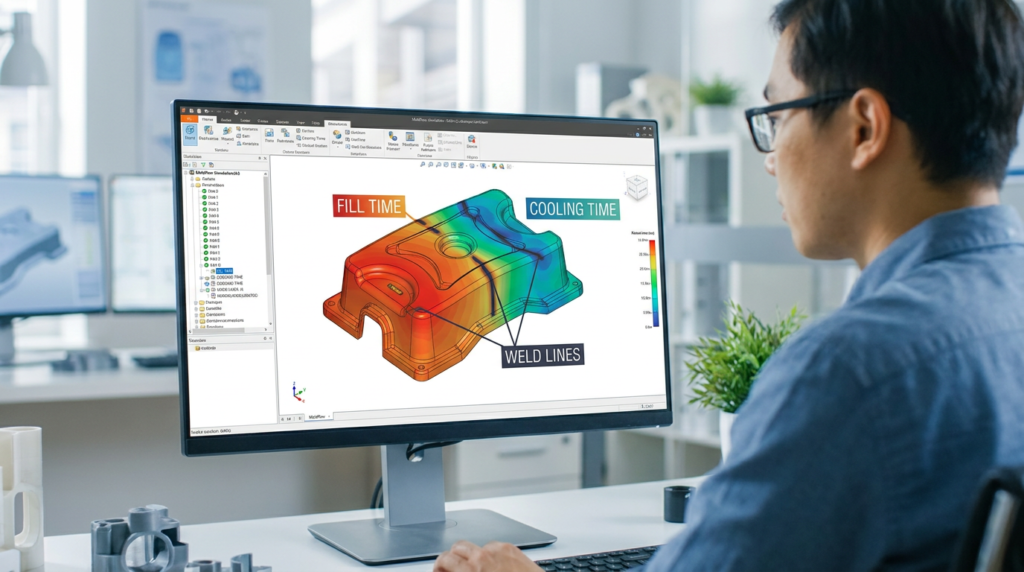
- Fill time analysis shows how the flow front advances through the cavity — non-simultaneous filling is the root cause of 60% of multi-cavity dimensional variation problems
- Cooling analysis reveals hot spots invisible to the designer — areas where the mold temperature exceeds the material HDT cause sink marks and extended cycle times
- Warpage simulation accuracy has improved to within 15–20% of measured warpage for most standard materials — sufficient to guide gate and cooling design decisions
- The ROI of mold flow analysis is overwhelmingly positive: a \,000–\,000 simulation investment routinely prevents \,000–\,000 in mold modifications
Mold flow analysis (also called injection molding simulation or Moldflow analysis) uses finite element analysis to simulate the injection molding process digitally before the mold is built. By predicting fill behavior, cooling performance, and part warpage in a computer model, simulation enables mold designers to optimize gate location, runner design, cooling circuit layout, and wall thickness — eliminating problems that would otherwise only be discovered at the first mold trial. This guide explains what mold flow analysis predicts, how to interpret key outputs, and the economics of simulation vs mold revision.
Further Reading
For neutral technical background, see injection molding background.
1. What Mold Flow Analysis Predicts
| Analysis Type | What It Shows | Design Decision It Informs |
|---|---|---|
| Fill analysis | Flow front position vs time; fill pressure; velocity | Gate location, gate size, wall thickness, runner sizing |
| Cooling analysis | Mold surface temperature; hot spots; cooling time | Cooling channel placement, conformal cooling need, cycle time |
| Warpage analysis | Part deflection and shape deviation after ejection | Gate location, material selection, cooling balance, wall uniformity |
| Weld line prediction | Location and angle of weld lines | Gate relocation; overflow wells; mold/melt temperature optimization |
| Sink mark analysis | Surface depression depth and location | Pack pressure; gate size; wall thickness uniformity |
| Fiber orientation (GF) | Fiber alignment direction in filled materials | Anisotropic shrinkage compensation; gate location for strength |
2. Key Simulation Outputs Explained
- Fill time (seconds) — Time from injection start to cavity full. Non-simultaneous filling between cavities or flow fronts indicates imbalance. Target: all cavity regions fill within 10% of the same time
- Injection pressure (bar) — Peak pressure at the gate. If simulation pressure exceeds machine capability (typically 1,500–2,000 bar), the part cannot be filled as designed — redesign gate or wall thickness
- Melt front temperature (°C) — If the flow front temperature drops below the material freeze temperature (>30°C below melt temp) before filling is complete, a short shot will occur
- Cooling time (seconds) — Time for the hottest point in the part to cool below the material’s ejection temperature. Cooling time is 60–70% of total cycle time — even 10% reduction adds significant annual output
- Deflection (mm) — Maximum part warpage after ejection and cooling. Plots show both magnitude and direction — essential for designing fixturing and setting go/no-go dimensional limits
3. How Simulation Influences Gate & Runner Design
- Gate location optimization — Simulation tests multiple gate positions in hours. Moving the gate from the geometric center to an edge may relocate a weld line from a structural rib to a non-critical surface — a change impossible to make after mold build without major rework
- Multi-gate balancing — For large or complex parts requiring multiple gates, simulation optimizes gate sizing and location to achieve simultaneous fill without overpacking near-gate regions
- Runner balance for multi-cavity — Simulation reveals pressure and temperature imbalances in conventionally balanced (equal length) runner systems caused by shear-induced melt heating — invisible to geometric analysis alone
- Hot runner nozzle positioning — For hot runner molds, simulation verifies that nozzle placement achieves target fill balance before the manifold is machined
4. Cooling Optimization Through Simulation
- Hot spot identification — Cooling analysis plots mold surface temperature at ejection. Hot spots (>10°C above average) correlate directly with sink marks, extended cooling time, and dimensional variation
- Conformal cooling ROI — Simulation quantifies the cycle time reduction from conformal cooling vs conventional straight-drilled channels. Typical results show 15–30% cycle time reduction — providing the data to justify higher tooling investment
- Cooling circuit layout — Simulation tests different channel layouts, diameters, and water temperatures to find the combination that minimizes both cycle time and temperature non-uniformity
- Core temperature — Deep cores are difficult to cool. Simulation identifies whether a standard bubbler is sufficient or whether a beryllium copper insert is required to meet cycle time targets
5. ROI: Cost of Simulation vs Cost of Mold Revision
| Scenario | Cost Without Simulation | Cost With Simulation | Net Savings |
|---|---|---|---|
| Gate relocation (T2 modification) | \\,000–\\,000 steel weld + re-machine | \\–\\,500 simulation | \\,500–\\,500 per modification |
| Cooling circuit redesign | \\,000–\\,000 re-drilling + delay | \\–\\,000 simulation | \\,000–\\,000 |
| Warpage > tolerance (restart) | \\,000–\\,000 mold rebuild | \\,000–\\,000 simulation | \\,000–\\,000 |
| Typical simulation investment | — | \\–\\,000 per mold | ROI 5–30× typical |
Mold flow analysis is standard practice at BuildMold for all complex molds, multi-cavity tools, and parts with tight dimensional requirements. Simulation results are shared with customers at the design review stage, with recommended design changes explained and documented before any steel is ordered.
🔗 Related Articles
Want Simulation Before Your Mold Builds?
We provide mold flow analysis reports with fill, cooling, and warpage predictions as part of our engineering review package. Contact us to learn more.
Or email us directly: sales@buildmold.com