
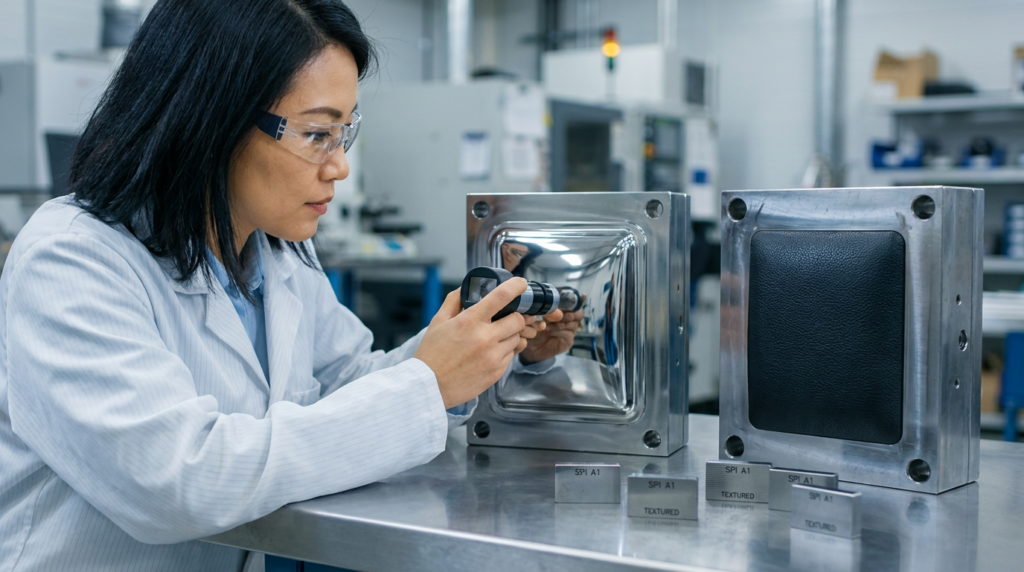
📌 Key Takeaways
- SPI A1 mirror finish (Ra 0.012μm) requires 9 polishing stages from 180-grit through 3μm diamond paste — and can take 40+ hours of skilled labor on a large cavity
- Mold texture must be matched to draft angle: EDM VDI 30 texture (Ra 3.2μm) requires a minimum 3° draft; VDI 45 requires 5° or parts will not eject cleanly
- Laser texturing can produce textures impossible with chemical etching — gradients, photographic images, and micro-structures with feature sizes under 50μm
- Surface finish affects coating adhesion: paint and soft-touch coating adhesion is significantly better on textured surfaces (Rz 3–10μm) than on mirror-polished surfaces
- EDM texture is defined by the discharge energy setting — higher energy creates rougher texture (higher VDI number) and deeper discharge craters
The surface finish of an injection mold cavity is directly transferred to every part it produces. A mirror-polished cavity produces glossy optical-quality parts; a textured cavity produces parts with leather grain, matte finish, or geometric patterns. Getting the surface finish right requires understanding the SPI (Society of the Plastics Industry) finish standards, the available finishing processes, and the interaction between surface texture, draft angle, and material selection.
Further Reading
For neutral technical background, see injection molding background.
1. SPI Surface Finish Standards
| SPI Grade | Ra (μm) | Process | Typical Application |
|---|---|---|---|
| A-1 | 0.012–0.025 | Diamond buff (3μm) | Optical lenses, transparent covers |
| A-2 | 0.025–0.050 | Diamond buff (6μm) | High-gloss cosmetic housings |
| A-3 | 0.050–0.100 | Diamond buff (15μm) | General gloss parts |
| B-1 | 0.100–0.200 | 600-grit paper | Semi-gloss, general consumer parts |
| B-2 | 0.200–0.400 | 400-grit paper | Low sheen surfaces |
| B-3 | 0.400–0.800 | 320-grit paper | Functional surfaces, non-cosmetic |
| C-1 | 0.800–1.600 | 600 stone | Slightly textured, hides sink marks |
| C-2 | 1.600–3.200 | 400 stone | General structural parts |
| D-1 | 3.200–6.300 | Dry blast (glass bead) | Matte finish, anti-fingerprint |
| D-2 | 6.300–12.500 | Dry blast (aluminum oxide) | Rough matte, industrial parts |
| D-3 | 12.500–25.000 | Grit blast | Heavy texture, grip surfaces |
2. Mirror Polishing Process
Achieving SPI A-1 or A-2 mirror finish is among the most skilled and labor-intensive operations in mold making. The process follows a strict sequence of abrasive grades, each removing the scratches from the previous stage:
- Stage 1 — Grinding: 180 → 320 → 400 grit abrasive stones remove EDM recast layer and machining marks
- Stage 2 — Paper polishing: 400 → 600 → 800 → 1200 grit wet-or-dry paper, applied with wooden sticks to conform to cavity contours
- Stage 3 — Diamond compound: 15μm → 9μm → 6μm → 3μm → 1μm diamond paste on felt bobs and cotton buff
- Stage 4 — Final buff: 0.5μm diamond or 0.1μm aluminum oxide on chamois leather
- Critical rule: Each stage must completely remove all scratches from the previous stage before proceeding. Skipping grades creates sub-surface scratches that reappear after a few thousand shots
3. EDM Texture (Spark Erosion Texture)
EDM texturing uses controlled electrical discharge to erode a pattern into the mold cavity surface. Unlike chemical etching, EDM texture is applied directly with the EDM machine using a shaped graphite or copper electrode — no chemicals required.
- VDI 3400 standard: The most widely used EDM texture reference. VDI numbers 12–45 correspond to Ra values of 0.4–18μm. Specify VDI number on your drawing.
- Discharge energy control: Lower energy (finer finish) settings produce shallower craters; higher energy produces deeper, rougher texture. Each VDI step represents approximately ×1.25 increase in Ra.
- Draft angle requirement: Every 0.025mm of Ra depth requires approximately 1° additional draft. VDI 30 (Ra 3.2μm) needs 3° minimum; VDI 45 (Ra ~18μm) needs 5–7°.
- Texture uniformity: EDM produces highly repeatable, uniform texture across the entire cavity surface — a key advantage over chemical etching, which can vary with acid concentration and temperature
4. Chemical Etching & Laser Texturing
- Chemical etching: Acid etching transfers a pattern from a photomask onto the mold surface. Can produce complex organic textures (leather, wood grain, fabric). Requires masking of non-textured areas. Depth control is less precise than EDM (±0.02–0.05mm variation).
- Laser texturing: A high-power laser removes material pixel-by-pixel according to a CAD file. Achieves feature sizes under 50μm — far finer than chemical etching. Can produce gradient textures, photographic images, and microstructures. No chemicals, fully reversible by re-polishing and re-lasering.
- Combined processes: High-end automotive and luxury consumer products often combine chemical etching for the macro pattern with laser texturing for micro-detail, creating a two-level texture with both visual depth and tactile quality
5. How Surface Finish Affects Part Quality
| Property | Mirror Finish (A1–A3) | Matte/Texture (C–D) |
|---|---|---|
| Sink mark visibility | Highly visible | Hidden — texture breaks up light reflection |
| Ejection difficulty | Higher (adhesion) | Lower (less contact area) |
| Paint/coating adhesion | Poor (needs priming) | Good (mechanical key) |
| Fingerprint visibility | High | Low |
| Part warpage visibility | High | Low |
| Polishing lead time | Long (20–40 hrs) | Short (EDM: automated) |
Surface finish selection should be made early in the design process — changing from matte to mirror finish after mold build requires full cavity re-polishing (costly and time-consuming), while going from mirror to matte requires re-texturing (faster). BuildMold provides surface finish samples for all SPI grades and common VDI textures to help customers make informed decisions before mold build begins.
Specifying Mold Surface Finish?
Request our SPI and VDI texture sample board and get a free consultation on draft angle and finish requirements for your part.
Or email us directly: sales@buildmold.com