
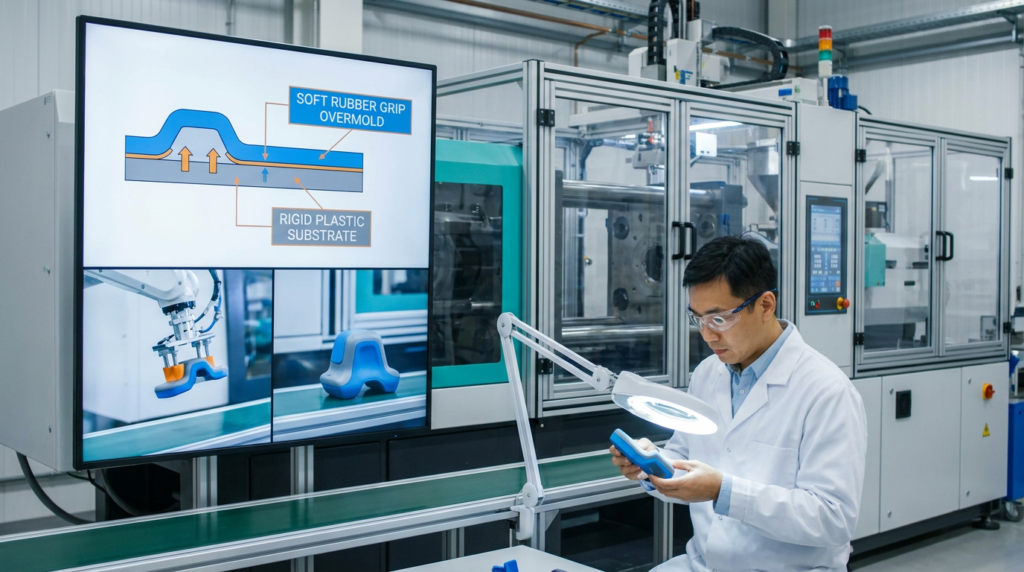
📌 Key Takeaways
- Overmolding bonds two materials in one mold — eliminating secondary assembly operations and reducing total part cost by 15–30% vs. separate parts plus assembly
- Chemical compatibility is the most common overmolding failure: ABS+TPE bonds well; POM+TPE bonds poorly — always verify compatibility before mold build
- Insert molding requires precise insert positioning: a 0.1mm insert misalignment creates wall thickness variation that causes cracking under mechanical load
- Brass inserts are the standard for threaded boss reinforcement: M3 brass inserts achieve 3–5× the pull-out strength of threads molded directly in plastic
- Two-shot (2K) molding produces overmolded parts in a single machine cycle using a rotating mold — higher tooling cost but lowest per-part labor cost at volume
Overmolding and insert molding are advanced injection molding processes that combine two or more materials or components into a single integrated part. These processes eliminate secondary assembly operations, improve ergonomics, create watertight seals, and add functional features (soft-touch grips, electrical contacts, threaded inserts) that cannot be achieved in a single-material injection molded part.
Further Reading
For neutral technical background, see injection molding background.
1. Overmolding vs Insert Molding
| Feature | Overmolding | Insert Molding |
|---|---|---|
| Process | Mold soft material over pre-molded plastic substrate | Place metal/plastic insert in cavity; inject plastic around it |
| Primary bond type | Chemical + mechanical | Mechanical encapsulation |
| Common material combo | ABS + TPE, PP + TPE, PC + TPU | Plastic + brass/steel inserts |
| Tooling complexity | High (2-shot rotary or transfer) | Medium (insert positioning fixtures) |
| Cycle time | Longer (two injection cycles) | Standard (one injection cycle + insert load time) |
| Best for | Soft-touch grips, seals, multi-color | Threaded bosses, electrical contacts, structural reinforcement |
2. Material Compatibility for Overmolding
| Substrate | TPE (Styrenic) | TPU | LSR (Silicone) | PP-based TPE |
|---|---|---|---|---|
| ABS | Excellent | Excellent | Requires primer | Good |
| PC | Good | Excellent | Requires primer | Poor |
| PP | Excellent (PP-based TPE only) | Poor | No bond | Excellent |
| PA (Nylon) | Good (special grades) | Good | No bond | Poor |
| POM | Poor — mechanical lock only | Poor | No bond | Poor |
3. Design Rules for Overmolding
- Overmold wall thickness — Minimum 0.8mm; recommended 1.5–3.0mm. Too thin causes incomplete fill; too thick causes sink marks in the overmold layer
- Mechanical interlocks — Where chemical bonding is weak (PP substrate + non-PP-based TPE), design undercut features or through-holes that create mechanical locking between layers
- Substrate draft angles — The substrate must have draft angles on all surfaces to be overmolded — the overmold cannot eject if the substrate is parallel-walled
- Gate location — Gate the overmold at the thickest section and furthest point from critical bond areas to ensure complete fill before the flow front reaches bond-critical zones
- Substrate pre-heating — In transfer overmolding, pre-heating the substrate to 60–80°C improves bond strength by 20–40% compared to room-temperature substrates
4. Insert Molding: Metal Inserts & Threads
- Brass threaded inserts — The most common insert type. Knurled exterior for mechanical retention. M2–M12 range. Pull-out strength: 500–5,000N depending on insert size and plastic wall thickness
- Heat-staked inserts — Pressed into a pre-molded boss post-molding using a heated tip. Lower tooling cost than insert molding but lower pull-out strength
- Ultrasonic inserts — Installed using ultrasonic vibration melting. Faster than heat staking; good for thermoplastics. Not suitable for thermosets
- Steel pins and shafts — Overmolded for hinge points, axles, and structural connectors. Require precise positioning fixtures to hold location during injection
- Electrical contacts & terminals — Copper alloy contacts overmolded with housing plastic in a single step. Standard process for connectors, switches, and sensor housings
5. Applications by Industry
| Industry | Overmolding Application | Insert Molding Application |
|---|---|---|
| Automotive | Soft-touch door handles, steering wheel grips, sealing gaskets | Sensor housings with metal terminals, fastener bosses |
| Medical | Ergonomic syringe grips, probe handles with soft-touch coating | Cannula overmolds, catheter hubs with metal reinforcement |
| Electronics | Waterproof cable connectors, soft-touch remote controls | USB connectors, PCB-mounted housing with metal contacts |
| Power tools | Bi-material grips (hard PP body + soft TPE grip zones) | Gearbox housings with steel shaft inserts |
| Consumer products | Toothbrush handles, kitchen tool grips, sports equipment | Watch cases with metal inserts, cosmetic packaging |
Overmolding and insert molding require close coordination between part designer, material supplier, and mold manufacturer from the earliest design stage. BuildMold has extensive experience with two-shot overmolding tooling and insert molding for automotive, medical, and electronics customers — and performs material compatibility testing before committing to mold design.
🔗 Related Articles
Need Overmolding or Insert Molding?
Send us your part design for a free process feasibility review and material compatibility assessment.
Or email us directly: sales@buildmold.com