
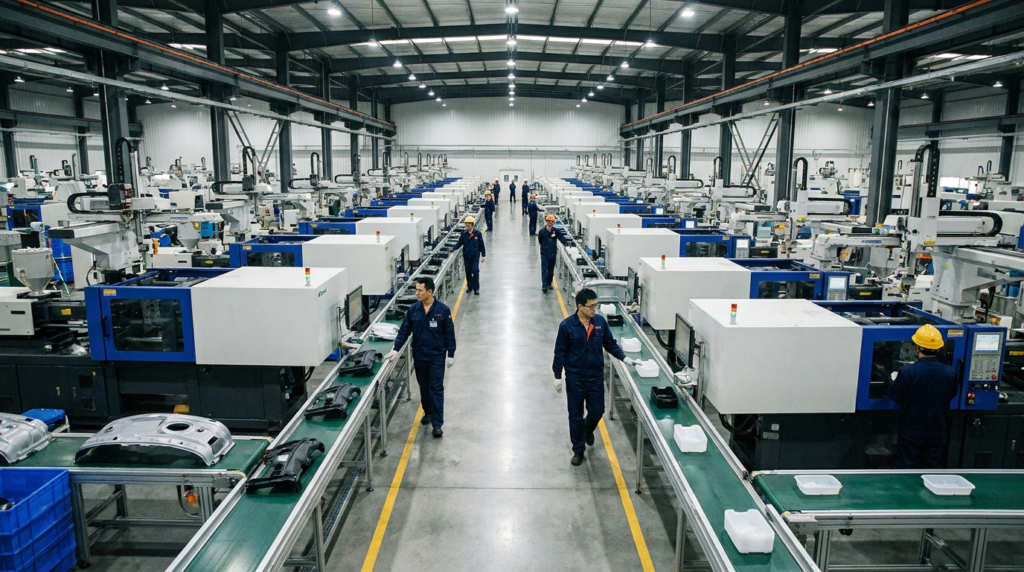
Thermoplastic injection molding is the most common type of molding in the world. It accounts for approximately 32% of all plastics processed globally and dominates plastic part manufacturing across every major industry. Within injection molding, the two-plate hot runner mold configuration is the most common tool design. No other molding process — blow molding, compression molding, rotational molding, or thermoforming — comes close to injection molding’s combination of speed, precision, design freedom, and per-part cost efficiency.
Further Reading
For neutral technical background, see injection molding background.
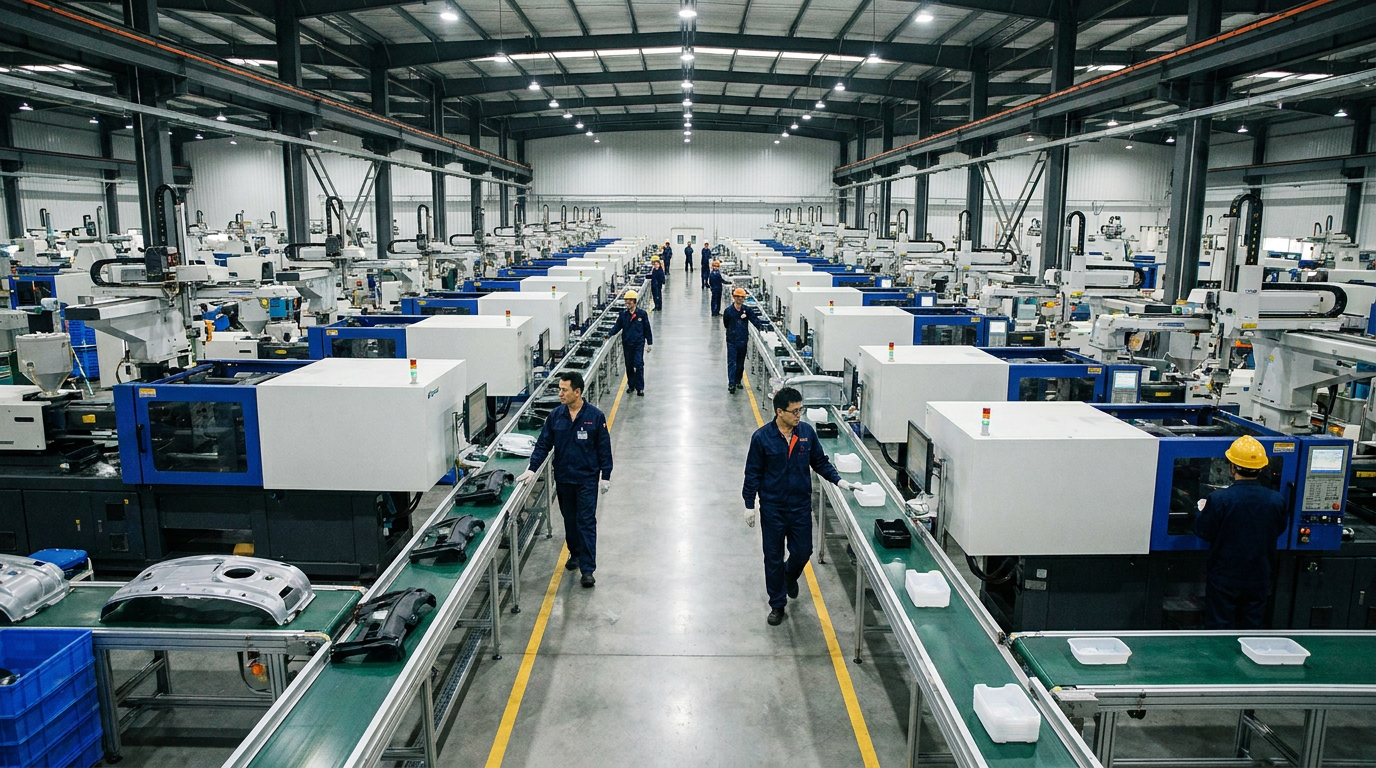
Why Thermoplastic Injection Molding Is the Most Common
| Factor | Injection Molding | Next Most Common (Blow Molding) |
|---|---|---|
| Global plastic processing share | ~32% of all plastics by weight | ~8% (hollow parts only) |
| Part complexity | Very high — 3D geometry, undercuts, threads | Low — hollow shapes only |
| Cycle time | 10–60 seconds | 15–60 seconds |
| Dimensional tolerance | ±0.05–0.1mm | ±0.1–0.5mm |
| Per-part cost at volume | Very low | Low (simpler parts) |
| Industries served | All industries | Packaging, containers |
The Most Common Molding Types Ranked
- Thermoplastic injection molding — By far the most common for discrete plastic parts. Used in automotive, medical, electronics, consumer goods, industrial equipment, and packaging. Accounts for approximately 32% of all plastics processed globally
- Blow molding — Second most common for parts (not profiles). Used exclusively for hollow shapes: bottles, containers, tanks. Cannot produce solid or complex 3D parts
- Thermoforming — Third most common. Heats plastic sheet and forms it over a mold. Used for trays, cups, packaging clamshells, large panels
- Compression molding — Used for thermosets, rubber, and composites. Car tires, electrical insulators, rubber gaskets, SMC automotive panels
- Rotational molding — Used for very large hollow parts: water tanks, playground equipment, kayaks. Low volume, slow cycle
Most Common Injection Molding Materials (By Volume)
| Rank | Material | Share of IM | Most Common Products |
|---|---|---|---|
| 1 | Polypropylene (PP) | ~30% | Automotive trim, packaging, consumer goods |
| 2 | ABS | ~15% | Electronics, appliances, toys |
| 3 | Polyethylene (PE) | ~12% | Caps, closures, containers |
| 4 | Polystyrene (PS) | ~8% | Packaging, disposables |
| 5 | Polyamide (PA/Nylon) | ~7% | Automotive, industrial, connectors |
| 6 | Polycarbonate (PC) | ~5% | Optical, medical, electronics |
| 7 | All others | ~23% | Engineering and specialty applications |
Most Common Injection Mold Configuration
Within injection molding, the most common mold design is the two-plate hot runner mold:
- Two-plate: Single parting line — the simplest, most cost-effective mold structure. The default choice for most parts
- Hot runner system: Eliminates runner waste, enables shorter cycle times, and allows more flexible gate placement. Standard for any high-volume production run (500,000+ parts/year)
- 4–8 cavities: The most common cavity count for medium-to-high volume production. Balances tooling cost against output rate
- H13 steel cavities: The most widely specified cavity steel for production molds, offering the best balance of hardness, toughness, and machinability
Most Common Industries Using Injection Molding
| Industry | Injection Molding Usage | Key Parts |
|---|---|---|
| Automotive | Largest consumer by value | Dashboards, bumpers, connectors, brackets |
| Packaging | Largest by volume | Caps, closures, containers, thin-wall cups |
| Medical | Fastest growing | Syringes, diagnostic housings, surgical instruments |
| Consumer electronics | High growth | Phone cases, connectors, housings |
| Consumer goods | Very high volume | Toys, appliances, household products |
Is injection molding more common than extrusion?
By weight, extrusion actually processes more plastic than injection molding (extrusion is used for films, pipes, and profiles — continuous products that account for enormous tonnage). However, for discrete manufactured parts, injection molding is by far the most common process.
What percentage of plastic parts are injection molded?
Approximately 32% of all thermoplastics processed globally are injection molded. When measured by number of discrete plastic parts (rather than weight), the percentage is higher — because injection molded parts tend to be smaller and more complex than extruded profiles or blow-molded containers.
Which country does the most injection molding?
China is the world’s largest injection molding producer, accounting for an estimated 30–40% of global output. The Pearl River Delta region of Guangdong Province — including Shenzhen, Dongguan, and Foshan — is the most concentrated hub of plastic injection mold manufacturing in the world.
Is 3D printing replacing injection molding?
Not for production volumes. 3D printing is growing rapidly for prototypes and custom one-off parts, but remains 100–1,000× more expensive per part than injection molding at production volumes. Injection molding’s dominance for high-volume production is not threatened by 3D printing in the foreseeable future.
Work With the World’s Most Proven Process
BuildMold has delivered 500+ injection molds to customers in 30+ countries. Free DFM review and quotation within 24 hours.