

A 3-plate mold (three-plate mold) is an injection mold design that uses two separate parting surfaces instead of one. The additional plate — the runner plate (or stripper plate) — sits between the cavity plate and the A-plate, creating a second parting line that automatically separates the runner system from the molded parts when the mold opens. This enables automatic degating at pin-point gates without requiring a hot runner system.
Further Reading
For neutral technical background, see injection molding background.
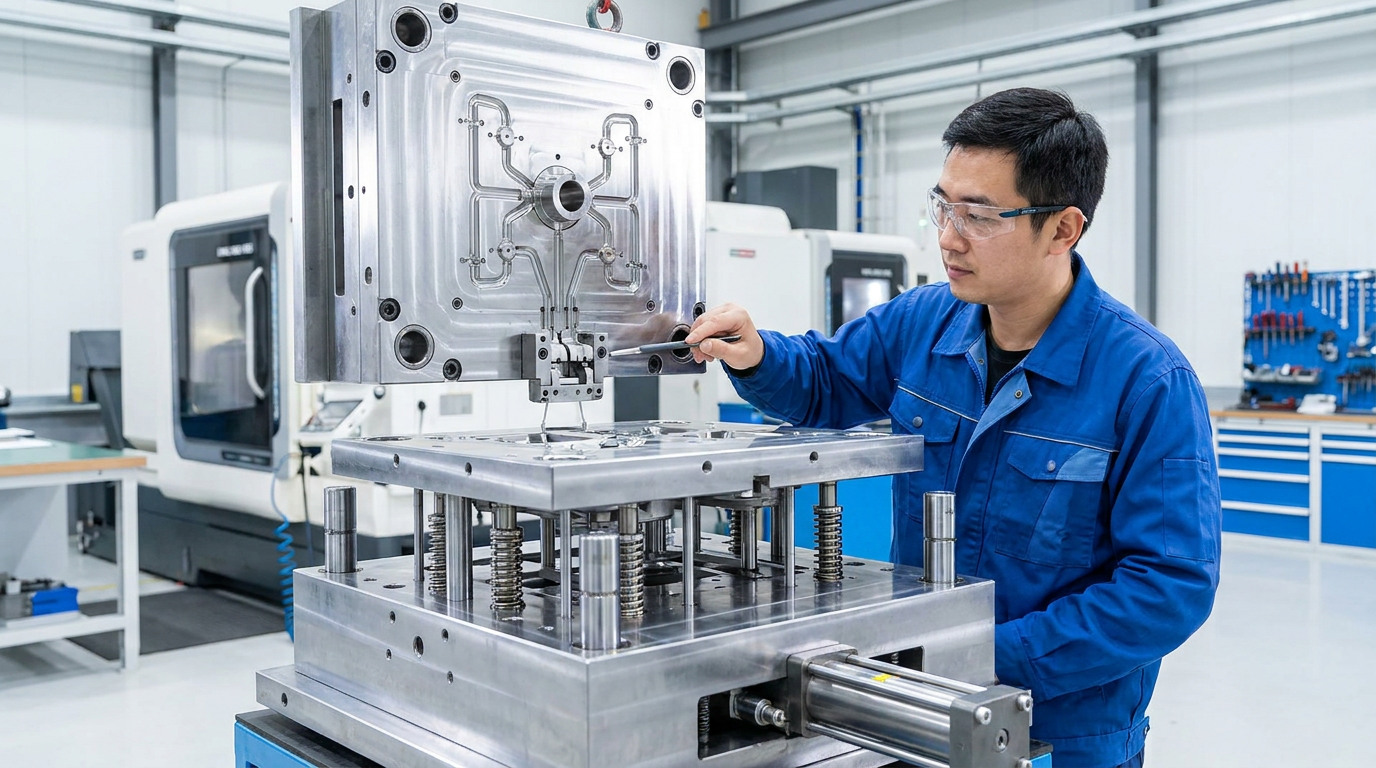
3-Plate Mold vs 2-Plate Mold: Key Difference
| Feature | 2-Plate Mold | 3-Plate Mold |
|---|---|---|
| Number of parting surfaces | 1 | 2 |
| Runner separation | Manual degating or hot runner | Automatic at pin-point gate |
| Gate location flexibility | Limited to parting line | Any location on part surface |
| Gate type | Edge, fan, tab, direct sprue | Pin-point gate (0.8–1.5mm diameter) |
| Runner waste | Yes (unless hot runner) | Yes (separate runner plate ejects runner) |
| Tooling cost | Lower | Higher (1.3–1.6× 2-plate) |
| Cycle time | Shorter (simpler motion) | Slightly longer (extra opening sequence) |
| Best for | Most standard parts | Center-gated, round, or symmetrical parts |
How a 3-Plate Mold Works: Step by Step
- Mold closed: All three plates are clamped together. Plastic is injected through the sprue in the top plate, along runners in the runner plate, through pin-point gates, and into cavities in the cavity plate
- First opening (PL1): The runner plate separates from the cavity plate at the first parting line. The runner system, still attached to the sprue puller, hangs between the runner plate and cavity plate
- Runner drop: The sprue puller releases and the runner system drops free, having been automatically broken off from the parts at the pin-point gates
- Second opening (PL2): The cavity plate separates from the core plate at the second parting line (same as a 2-plate mold), revealing the finished parts still on the cores
- Ejection: Ejector pins push the parts off the core. The runner drops into a separate collection bin. Both parts and runner are ejected cleanly in one cycle
The Three Plates Explained
| Plate | Also Called | Function |
|---|---|---|
| Top plate (A-side) | Cavity plate / fixed half | Contains the cavity (part geometry); houses the sprue bushing |
| Runner plate | Stripper plate / floating plate | Contains the runner channels and pin-point gate bushings; floats between the other two plates |
| Bottom plate (B-side) | Core plate / moving half | Contains the core; houses the ejector system |
Advantages of 3-Plate Molds
- Centre gating without hot runner cost: The biggest advantage. Pin-point gates can be placed at the geometric centre of the part or at any location not accessible from the parting line — without the expense of a hot runner system
- Automatic degating: Runner separates automatically at the pin-point gate when the mold opens. No secondary degating operation required, reducing labour cost
- Better fill balance: Centre gating produces a radially symmetric flow front, eliminating the directional fill imbalance seen with edge-gated parts. Reduces warpage in round and symmetrical parts
- Minimal gate vestige: Pin-point gates leave a tiny circular mark (typically 0.8–1.5mm diameter) that is far less visible than an edge gate mark
- Multi-point gating without hot runner: Multiple pin-point gates can be used to fill large or complex parts at several locations simultaneously, reducing fill pressure and weld line visibility
Disadvantages of 3-Plate Molds
- Higher tooling cost: The additional runner plate, extra guide pins, sprue puller mechanism, and more complex opening sequence add 30–60% to tooling cost vs a comparable 2-plate mold
- Runner waste: Unlike hot runner systems, 3-plate molds still generate runner waste every cycle. The runner must be collected, reground (if material allows), or discarded
- Longer cycle: The extra mold opening sequence (two parting surfaces opening sequentially) adds 1–3 seconds per cycle vs a 2-plate mold
- More complex maintenance: Additional moving components (floating plate, sprue puller, secondary ejectors) require more maintenance attention
- Limited to smaller parts: Very large or heavy parts are not well-suited to 3-plate molds because the floating runner plate must support the weight of the runner system during separation
When to Choose a 3-Plate Mold
- Round, symmetrical parts that benefit from centre gating (gears, wheels, lenses, round housings) — where a central gate produces better fill balance than any edge gate location
- Cosmetically critical parts where the gate mark location is restricted and cannot be placed on the parting line — but the budget does not justify a hot runner system
- Multi-gate requirement on parts that are too large or complex to fill from a single gate — where multiple pin-point gates reduce injection pressure and improve fill balance
- Medium production volumes (50,000–500,000 parts) where runner waste is acceptable but hot runner cost is difficult to justify
- Materials that are easy to degate cleanly: Rigid amorphous materials (ABS, PS) degate cleanly at pin-point gates. Flexible or reinforced materials (GF-filled grades, TPE) may not break cleanly and are better suited to hot runner systems
What is the difference between a 2-plate and 3-plate mold?
A 2-plate mold has one parting line and the runner is ejected with the part (requiring manual degating). A 3-plate mold has two parting lines — the second separates the runner automatically at the pin-point gate, so parts and runner are cleanly separated every cycle without manual intervention.
Does a 3-plate mold need a hot runner?
No — the 3-plate mold was designed specifically to achieve centre gating and automatic degating without a hot runner system. It is a cold runner alternative to hot runners for applications requiring flexible gate placement. However, a 3-plate mold can also be combined with a hot runner system for maximum flexibility.
What gate size is used in a 3-plate mold?
Three-plate molds use pin-point gates, typically 0.8–1.5mm in diameter. The small gate diameter allows clean, automatic breakoff when the runner plate separates. Larger gates would not break cleanly, defeating the purpose of the 3-plate design.
Is a 3-plate mold more expensive than a hot runner mold?
Generally, a 3-plate mold is less expensive than a comparable hot runner mold. Hot runner systems add \,000–\,000 per drop; a 3-plate runner plate adds a flat cost of \,000–\,000 regardless of cavity count. At high cavity counts, hot runners become relatively more cost-effective.
Need a 2-Plate, 3-Plate, or Hot Runner Mold?
BuildMold recommends the optimal mold configuration for your part, volume, and budget. Free DFM review and mold type recommendation within 24 hours.