
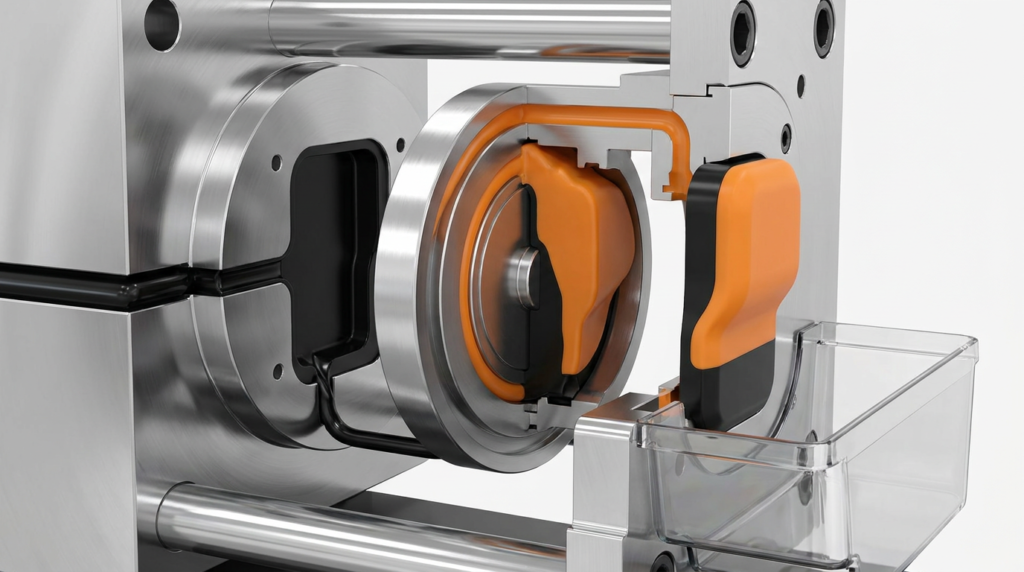
The 2K process (also called two-shot moulding, dual-shot moulding, or 2-component injection moulding) is an injection moulding technique where two different plastic materials are injected sequentially into the same mold in a single machine cycle, producing a finished multi-material part without any secondary assembly. The “2K” stands for “2 Komponenten” (German for “2 components”).
Further Reading
For neutral technical background, see injection molding background.
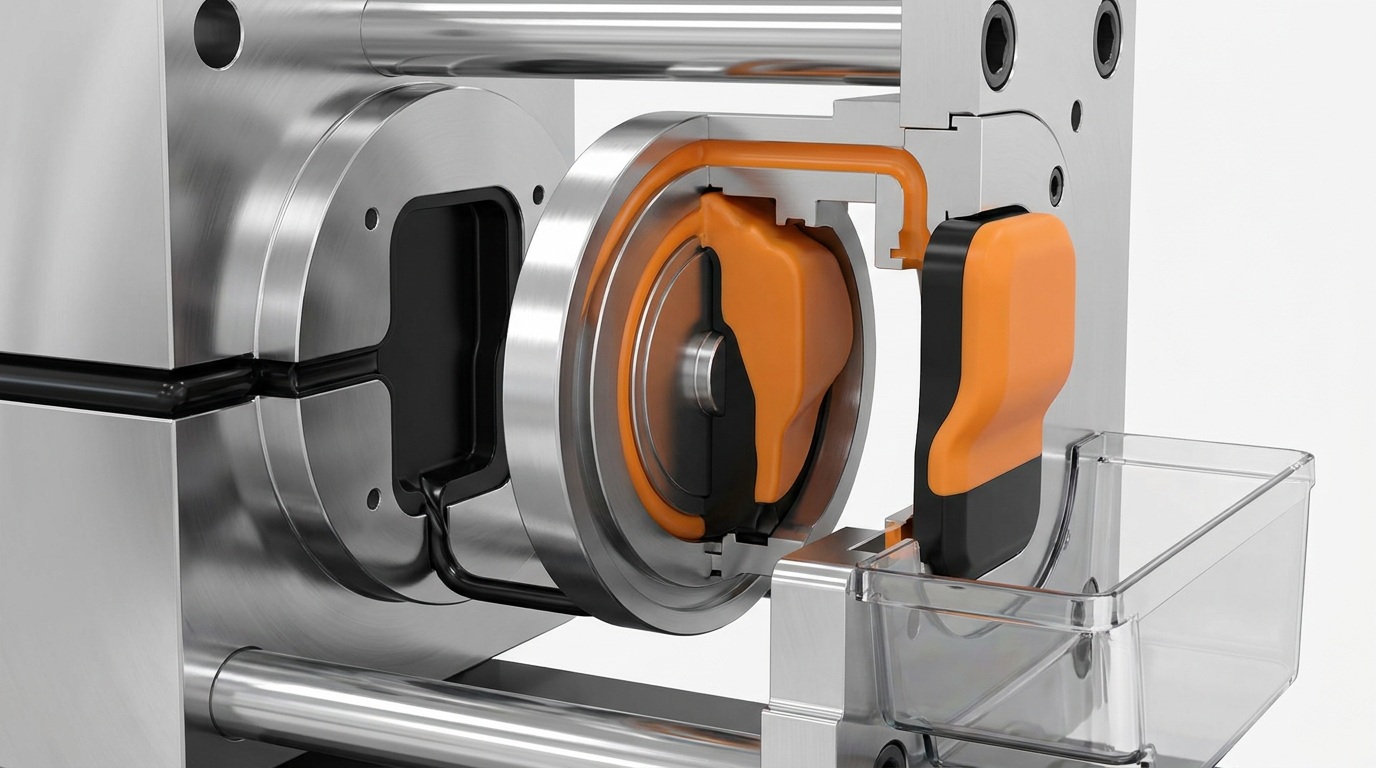
How the 2K Process Works
- First shot (substrate): The first material (typically a rigid thermoplastic like ABS, PC, or PP) is injected into the first cavity position and cooled to form the substrate part
- Mold rotation: The mold rotates (typically 180°) on a rotating platen or the part is transferred to a second cavity by robot, without opening the mold fully
- Second shot (overmold): The second material (typically a soft TPE, TPU, or silicone) is injected around or onto the substrate in the second cavity position, bonding to it chemically and/or mechanically
- Ejection: The completed two-material part is ejected from the mold. Both shots happen simultaneously in production — while one part gets its second shot, a new substrate is being formed for the next cycle
2K vs Overmoulding: What’s the Difference?
| Feature | 2K (Two-Shot) | Overmoulding (Insert Moulding) |
|---|---|---|
| Process | Both shots in one machine, one cycle | Substrate moulded separately; transferred to second machine |
| Machine required | Specialized 2K injection machine | Two standard injection machines |
| Cycle time | One combined cycle (faster) | Two separate cycles (slower) |
| Labour | Fully automated | Requires substrate transfer (manual or robot) |
| Bond quality | Excellent (hot substrate improves bonding) | Good (cold substrate reduces bonding slightly) |
| Tooling cost | Higher (rotating mold mechanism) | Lower (two simpler molds) |
| Volume suitability | High volume (justify machine investment) | Low-medium volume |
Material Combinations in 2K Moulding
The key to successful 2K moulding is material compatibility — the two materials must bond chemically and/or mechanically:
| Substrate (Shot 1) | Overmould (Shot 2) | Bond Type | Typical Application |
|---|---|---|---|
| ABS | TPE (Styrenic) | Chemical + mechanical | Tool handles, toothbrush grips |
| PC | TPU | Chemical | Medical device grips, wearables |
| PP | PP-based TPE | Chemical (same polymer family) | Automotive seals, soft-touch trim |
| PA (Nylon) | TPE (special grade) | Mechanical + limited chemical | Industrial grips, connectors |
| ABS | PC (second colour) | Melt bonding | Two-colour automotive trim, buttons |
| PC | PMMA (clear) | Melt bonding | Tail lamp lenses with clear window |
Advantages of the 2K Process
- Eliminates secondary assembly: No gluing, welding, or mechanical fastening needed to join two materials — the bond is formed during moulding, saving labour cost and assembly time
- Superior bond strength: The chemical bond formed when the second material is injected onto the hot substrate is stronger than adhesive or mechanical joining in most cases
- Design freedom: Enables complex multi-material geometries impossible with secondary assembly — soft seals integrated into rigid housings, internal soft-touch surfaces, colour-without-paint
- Consistent quality: Fully automated process with no human assembly variation; every part identical
- Material savings: Soft TPE used only where needed (grip zones, seals) rather than the entire part
- Reduced part count: One 2K part replaces two separately moulded and assembled parts
Typical 2K Products
- Power tool handles: Rigid PA or ABS body with soft TPE grip zones and vibration-damping pads — one of the largest 2K application categories
- Toothbrush handles: Rigid PP core with soft TPE grip and rubber-like cleaning elements in a single moulded part
- Automotive interior: Two-colour instrument panel trim, soft-touch dashboard inserts, integrated seals on door panels
- Medical devices: Rigid PC housing with soft TPU grip and integrated gasket seal in one part
- Consumer electronics: Two-colour phone cases, soft-touch remote controls, waterproof seals integrated into housings
- Connector housings: Rigid PA base with integrated TPE strain relief and sealing lip
2K Mould Design Considerations
- Rotating platen vs index plate: Most 2K molds use a 180° rotating core half. The cavity half has two positions (one per shot). Index plate designs rotate the part within the mold on a turntable
- Core alignment: After rotation, the core must realign precisely (±0.02mm) with the second cavity. Guide pins and precision bearings are critical
- Gate design: Each shot requires its own gate system. Hot runner valve gates are preferred for the second shot to avoid cold slug at the gate when the mold reopens
- Venting: The second shot must vent air displaced as the overmould material fills around the substrate
- Wall thickness balance: The substrate must be thick enough to withstand the injection pressure of the second shot without deflection
Frequently Asked Questions
What does 2K mean in injection moulding?
2K stands for “2 Komponenten” (German for 2 components). It refers to injection moulding processes that combine two different plastic materials in a single mold cycle to produce one integrated multi-material part. Also called two-shot, dual-shot, or bi-injection moulding.
Is 2K moulding the same as overmoulding?
They achieve the same result (a two-material part) but differ in process. 2K moulding uses one specialized machine with a rotating mold — both shots happen in the same machine cycle. Overmoulding uses two separate machines — the substrate is moulded first, then transferred to a second machine for the second shot. 2K is more automated and better suited to high volumes.
What materials can be used in 2K moulding?
Any two thermoplastics that are chemically compatible (or mechanically bondable) can be used. The most common combinations are rigid ABS/PC/PP substrates with soft TPE/TPU overmoulds. Two rigid materials of different colours (ABS over ABS) are also common for two-colour automotive and consumer parts.
How much does a 2K mold cost?
A 2K mold typically costs 2–3× more than a comparable single-material mold, due to the rotating mechanism, precision alignment requirements, and two separate gate systems. Expect \,000–\,000+ for a production 2K tool, depending on part complexity and cavity count.
What is the difference between 2K and 3K moulding?
2K moulding uses two materials; 3K moulding (three-component) uses three. 3K is rare and requires highly specialized machines. It is used for very specific applications requiring three distinct material properties in one part, such as a rigid core, soft grip, and clear window combined.
🔗 Related Articles
Need a 2K or Overmoulding Solution?
BuildMold designs and manufactures two-shot and overmould tools for automotive, medical, and consumer applications. Free DFM review and material compatibility analysis — contact us today.