
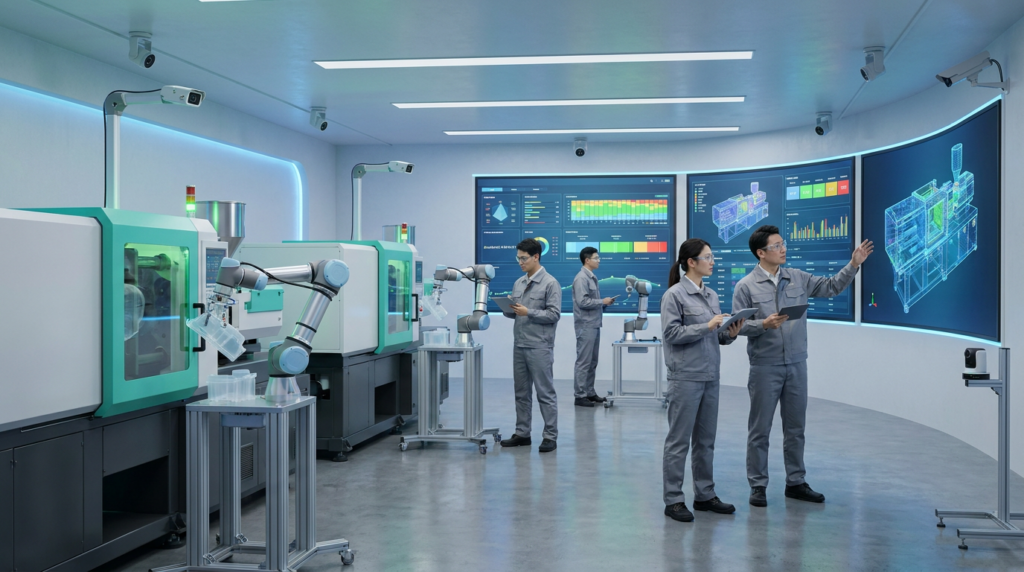
The future of injection molding is defined by five major trends: AI-driven process optimization, Industry 4.0 smart factories, sustainable materials and circular economy, electric vehicle component demand, and micro and nano-scale precision. Injection molding is not being replaced — it is being upgraded. The global injection molding market is projected to grow from approximately \ billion in 2024 to over \ billion by 2032, driven by EV adoption, medical device growth, and reshoring trends.
Further Reading
For neutral technical background, see injection molding background.
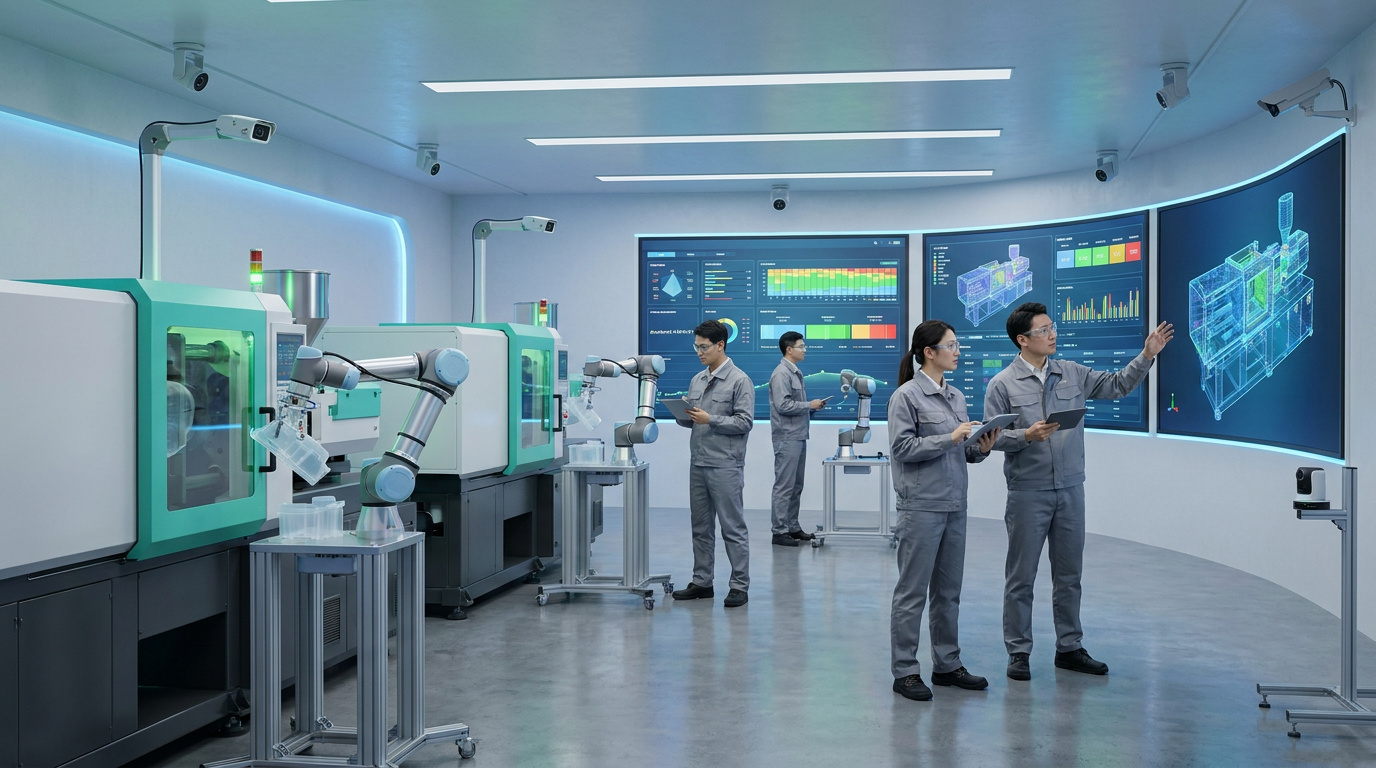
Market Outlook: Injection Molding Growth to 2032
| Year | Market Size (USD) | Key Growth Driver |
|---|---|---|
| 2024 (current) | ~\ billion | EV, medical, consumer electronics |
| 2026 (projected) | ~\ billion | EV battery housing ramp; medical device expansion |
| 2028 (projected) | ~\ billion | Reshoring; bioplastics adoption; smart manufacturing |
| 2030 (projected) | ~\ billion | Autonomous manufacturing; circular economy |
| 2032 (projected) | ~\ billion | Full AI integration; sustainable materials mainstream |
Trend 1: AI and Machine Learning in Process Optimization
Artificial intelligence is transforming injection molding from an experience-driven craft into a data-driven science. AI systems are being deployed to optimize processes that previously required years of expert knowledge:
- Real-time process correction: AI algorithms monitor hundreds of process variables (cavity pressure, melt temperature, injection velocity) in real time and make micro-corrections every cycle to maintain part quality despite material variation or environmental changes
- Predictive defect detection: Machine learning models trained on thousands of shots predict when a defect (sink mark, warpage, short shot) is about to occur — before the part is ejected — enabling preemptive correction
- Automated process development: AI-assisted design of experiments (DOE) can establish process windows in hours rather than days, dramatically reducing mold trial time and cost
- Digital twin integration: Real-time digital twins of the injection molding process compare actual machine data against a simulated model, immediately flagging deviations from the validated process
- Predictive maintenance: AI monitors machine wear patterns (screw wear, check ring performance, heater degradation) and predicts maintenance needs before failures occur, reducing unplanned downtime
Trend 2: Industry 4.0 and Smart Factories
Injection molding facilities are evolving from collections of individual machines into integrated, networked smart factories:
- Connected machines (IIoT): Every injection molding machine, robot, and auxiliary unit is connected to a central data platform. Real-time dashboards show OEE (Overall Equipment Effectiveness), cycle time, reject rate, and energy consumption across the entire facility
- Automated material handling: Central drying systems with RFID material tracking automatically deliver the correct pre-dried resin to each machine, eliminating material errors and reducing drying variability
- Inline vision inspection: High-speed cameras inspect 100% of parts at the machine, replacing manual sampling. Defective parts are automatically sorted; data feeds back to the process control system
- Lights-out manufacturing: Fully automated cells run 24/7 without operators. Robots handle part removal, degating, assembly, inspection, and packaging. Human intervention is required only for mold changes and maintenance
Trend 3: Sustainable Materials and Circular Economy
Environmental pressure is reshaping injection molding material choices and business models:
| Development | Current Status | Impact by 2030 |
|---|---|---|
| Bio-based polymers (PLA, PHA, bio-PP) | Growing; 2–5% market share | 10–15% share in packaging and disposables |
| Post-consumer recycled (PCR) content | 0–30% in most applications | 30–50% mandated in EU packaging by 2030 |
| Chemical recycling feedstocks | Early commercial stage | Enables “virgin equivalent” recycled resin at scale |
| Biodegradable composites | Niche applications | Growing in food service and agricultural applications |
| Mold-as-a-service / extended producer responsibility | Emerging business models | Mold makers partnering in product lifecycle management |
Trend 4: Electric Vehicle Demand Surge
The global transition to electric vehicles is one of the most significant demand drivers for injection molded parts in the 2025–2035 decade:
- Battery system housings: EV battery packs require large, complex, flame-retardant injection molded housings in PA-GF, PC/ABS, and specialty composites. Each EV contains 5–15 large battery housing components
- High-voltage connectors: EVs require 3–5× more electrical connectors than combustion vehicles. Precision LCP and PA66 connectors are injection molded components experiencing rapid demand growth
- Thermal management: EV battery cooling systems use complex injection molded PP and PA manifolds, pipes, and reservoirs — parts not required in combustion vehicles
- Structural lightweighting: As EV range anxiety drives weight reduction, injection molded structural composites (long-fibre thermoplastics, organic sheets) are replacing metal in structural applications
- Charging infrastructure: Millions of EV charging stations each require numerous injection molded housings, connectors, and components
Trend 5: Precision at Micro and Nano Scale
Demand for ever-smaller, ever-more-precise injection molded components is growing rapidly, driven by medical devices, microelectronics, and implantable technology:
- Micro injection molding: Parts weighing 0.001–0.1g with features measured in microns are now producible in volume. Hearing aid components, micro-fluidic chips, and minimally invasive surgical tools are driving this segment
- Optical precision molding: Aspheric lens elements for cameras, AR/VR headsets, and LiDAR sensors require surface accuracy better than 50nm (0.00005mm) — pushing the limits of steel polishing and process control
- In-mold electronics (IME): Conductive inks and electronic components are integrated directly into the molded part during the injection process, creating structural electronics without assembly
- Bio-absorbable medical parts: Injection molded PLA and PLGA implants that dissolve in the body after performing their function eliminate second surgeries for implant removal
What Will NOT Change
Despite all these advances, the fundamental physics of injection molding will not change:
- Molten plastic will still be injected into a steel mold and cooled to form parts — the process is thermodynamically optimal for high-volume plastic part production
- Steel mold making will remain a skilled trade — AI and automation assist but cannot fully replace the judgment of experienced tooling engineers
- DFM (Design for Manufacturability) will remain essential — no amount of AI can compensate for a part with zero draft angles or incompatible wall thicknesses
- Injection molding will remain the dominant plastic part manufacturing process for high-volume production through at least 2040
Will 3D printing replace injection molding?
No — not for production volumes. 3D printing will continue to grow for prototypes, custom parts, and low-volume production, but cannot match injection molding’s speed or cost efficiency at scale. The two processes are complementary: 3D printing for development and customization, injection molding for volume production.
How will AI change injection molding jobs?
AI will eliminate some low-skill monitoring roles but create demand for higher-skill positions: data scientists who train process models, engineers who interpret AI outputs, and technicians who maintain automated systems. The total number of injection molding jobs may decrease slightly but the average skill level and compensation will increase.
What is the fastest growing segment of injection molding?
Electric vehicle components and medical devices are the two fastest-growing segments. EV adoption is creating new demand for battery housings, connectors, and thermal management components. Ageing global populations and expanding healthcare access are driving medical device volume growth at 7–10% annually.
Will injection molding become more sustainable?
Yes — driven by regulatory pressure (EU packaging regulations, single-use plastic bans) and customer demand. Bio-based polymers, post-consumer recycled content, hot runner systems that eliminate runner waste, and energy-efficient all-electric machines are all reducing injection molding’s environmental footprint.
🔗 Related Articles
Partner With a Future-Ready Mold Maker
BuildMold invests in precision CNC, digital quality systems, and engineering expertise to stay at the forefront of injection mold manufacturing. Free DFM review and quotation within 24 hours.