
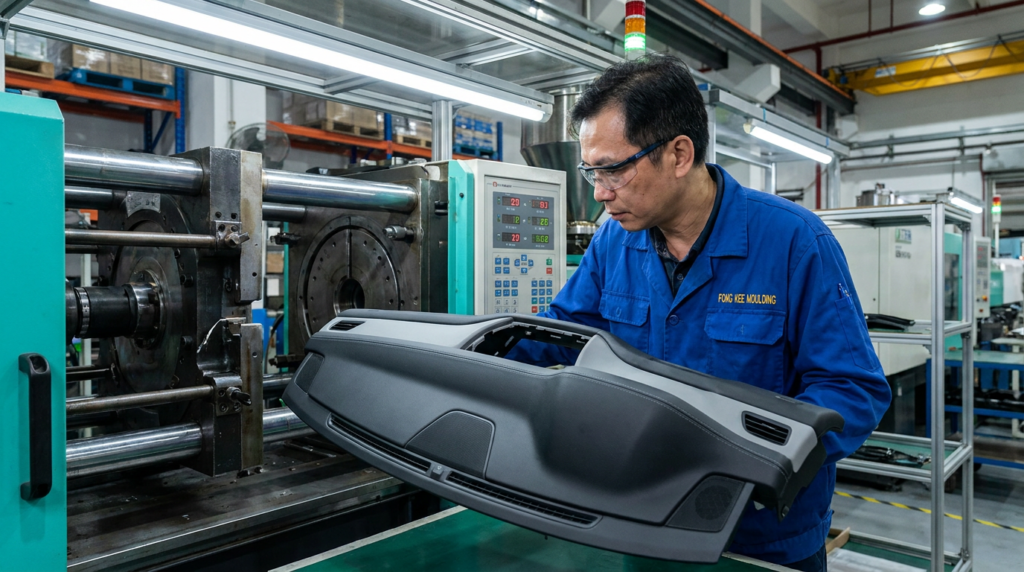
What is the 2K process in injection molding? 2K moulding — also known as two-shot moulding, dual-shot moulding, or two-component injection moulding — is an advanced injection moulding process that produces a single part from two different materials or colours in one automated moulding cycle. The result is a finished multi-material component that emerges from the mould without any manual assembly, bonding, or secondary operations.
Further Reading
For neutral technical background, see injection molding background.
2K moulding is one of the most innovative and value-adding technologies in modern plastic part production, widely used in automotive, consumer electronics, medical, and consumer goods manufacturing.
How Does the 2K Process Work?
The 2K process uses a specialised injection moulding machine with two separate injection units — each with its own barrel, screw, and hopper — feeding into a single, rotating or indexing mould. The process follows these steps:
- First shot: The first injection unit injects the primary material (substrate) into the first mould cavity, forming the core component.
- Mould rotation or indexing: The mould rotates (typically 180°) or indexes to align the first-shot component with the second cavity.
- Second shot: The second injection unit injects the second material (overmould) around or over the first component — bonding chemically and/or mechanically to create a unified part.
- Ejection: The finished two-material part is ejected. Simultaneously, a new first shot is injected in the original position — allowing continuous, overlapping production.
Because both shots happen in the same moulding cycle, 2K moulding achieves excellent interlayer adhesion, precise registration between components, and zero assembly labour.
2K Moulding vs Overmoulding: What Is the Difference?
| Feature | 2K Moulding (Two-Shot) | Insert Overmoulding |
|---|---|---|
| Process | Both shots in single machine cycle; mould rotates/indexes | First part moulded separately, then manually placed into mould for overmoulding |
| Equipment | Specialised 2K machine with 2 injection units | Standard single injection unit machine | Cycle efficiency | Very high — both shots happen simultaneously | Lower — manual insert handling between shots |
| Labour | Minimal — fully automated | Higher — operator loads inserts |
| Part registration | Excellent — mechanically controlled | Risk of misalignment during manual loading |
| Tooling cost | Higher — complex rotating mould + 2K machine | Lower — simpler mould, standard machine |
| Best for | High-volume, precision multi-material parts | Lower volume, larger parts, metal/plastic combinations |
Material Combinations in 2K Moulding
Not all material pairs bond well in 2K moulding. Successful 2K combinations require either chemical compatibility (molecular bonding at the interface) or mechanical interlocking (geometric features that physically lock the two materials together).
Common 2K Material Pairs
| Substrate (1st Shot) | Overmould (2nd Shot) | Application |
|---|---|---|
| ABS | TPE / TPU | Tool handles, toothbrush grips, consumer electronics |
| PC | TPU | Phone cases, protective covers |
| PA66 (Nylon) | TPE | Power tool housings, automotive interior handles |
| PP | TPE | Automotive seals, food container lids |
| ABS | ABS (different colour) | Automotive buttons, control panels, appliance knobs |
| PC/ABS | Soft-touch TPE | Medical device grips, consumer electronics |
| POM | TPU | Gear assemblies with damping elements |
Key Rule: Material Compatibility
Materials with similar chemical structures tend to bond chemically. For example, ABS (styrene-based) bonds well with styrene-based TPE. PP bonds well with PP-based TPE. When chemical bonding is insufficient, mechanical interlocking through holes, undercuts, or surface texture in the first shot compensates.
Typical Applications of 2K Moulding
Automotive
- Interior trim panels with soft-touch overmould on rigid substrate
- Steering wheel buttons combining rigid PC substrate with tactile TPE surface
- Door handle grips (PA66 + TPE)
- Tail light lenses combining clear PC with coloured PC in one shot
Consumer Electronics
- Smartphone cases — rigid PC inner shell + shock-absorbing TPU outer layer
- Remote controls — ABS housing with rubberised grip zones
- Earphone bodies combining hard and flexible sections in single parts
Medical Devices
- Surgical instrument handles — ergonomic TPE grip over PP substrate
- Inhaler bodies with integrated soft valve components
- Diagnostic device housings with sealed soft membrane zones
Power Tools and Consumer Goods
- Tool handles — vibration-dampening TPE over PA or PP substrate
- Toothbrush handles — PP core with TPE grip zones and fin elements
- Kitchen utensil handles combining rigid structure with soft grip
Advantages of the 2K Process
- Eliminates assembly: No bonding, welding, or mechanical fastening required — reduces labour cost and assembly defects
- Superior bond strength: Chemical bonding between compatible materials is stronger and more durable than adhesive or mechanical joining
- Precise registration: Mould-controlled alignment ensures perfect, repeatable positioning of the two materials
- Design freedom: Enables complex multi-material geometries — soft-touch zones in precise locations, dual-colour designs, integrated sealing elements
- Cycle efficiency: Both shots occur in overlapping cycles — effectively doubling throughput versus sequential single-shot + assembly operations
- Reduced supply chain complexity: One part number replaces two or more — simplifying inventory, quality control, and logistics
Disadvantages and Challenges of 2K Moulding
- Higher machine cost: 2K machines with two injection units and rotating mould systems cost 2–4× more than equivalent single-shot machines
- Complex tooling: Rotating or indexing moulds are significantly more complex and expensive ($30,000–$200,000+) than single-material tools
- Material compatibility constraints: Not all material pairs work — selection is limited by chemical and thermal compatibility
- Process sensitivity: Achieving consistent interlayer adhesion requires precise control of first-shot surface temperature at the time of second injection — process window is narrower than single-material moulding
- Longer lead time: 2K mould design and fabrication typically takes 2–4 weeks longer than equivalent single-shot tooling
Frequently Asked Questions
What does 2K mean in injection molding?
2K stands for “zwei Komponenten” (German for “two components”) — reflecting the process’s origin in German automotive manufacturing. It refers to an injection moulding process that combines two different materials or colours in a single, automated moulding cycle to produce a unified multi-material part.
What is the difference between 2K moulding and overmoulding?
2K moulding uses a specialised machine with two injection units and a rotating mould — both shots happen in one automated cycle without manual handling. Overmoulding uses a standard machine where the first-shot part is manually or robotically placed into a second mould for overmoulding. 2K is faster and more precise at high volumes; overmoulding is more flexible and economical at lower volumes.
What materials are used in 2K injection moulding?
Common material combinations include ABS + TPE, PC + TPU, PP + TPE, and PA66 + TPE for rigid/soft-touch applications, and ABS + ABS or PC + PC for dual-colour cosmetic parts. The two materials must be thermally and chemically compatible — processing temperatures must be similar enough to not damage the first shot during the second injection.
How much does 2K injection moulding cost?
2K tooling typically costs 1.5–3× more than equivalent single-shot tooling, reflecting the rotating mould mechanism and dual-cavity design. Machine costs are also higher. However, the elimination of assembly operations and the superior bond quality compared to adhesive bonding often justify the additional tooling investment at volumes above 50,000–100,000 parts per year.
Is 2K moulding the same as bi-injection moulding?
Yes — 2K moulding, two-shot moulding, dual-shot moulding, and bi-injection moulding are all terms for the same fundamental process: producing a single part from two materials in one automated injection moulding cycle. The specific terminology varies by region and industry.
What industries use 2K injection moulding?
The main industries are automotive (interior trim, buttons, handles), consumer electronics (phone cases, remote controls, earphones), medical devices (surgical handles, inhaler bodies), power tools (handles, housings), and consumer goods (toothbrushes, kitchen utensils, sporting goods). Any application requiring a combination of rigid structure with soft-touch, sealing, or aesthetic elements is a candidate for 2K moulding.
Summary
The 2K injection moulding process is a powerful technology that enables multi-material, multi-colour plastic parts to be produced in a single automated cycle — eliminating assembly, improving bond strength, and enabling design combinations impossible with single-material moulding. While it demands greater investment in specialised equipment and complex tooling, the operational efficiency, part quality, and design freedom it delivers make it the preferred solution for high-volume multi-material applications across automotive, electronics, and medical industries.