
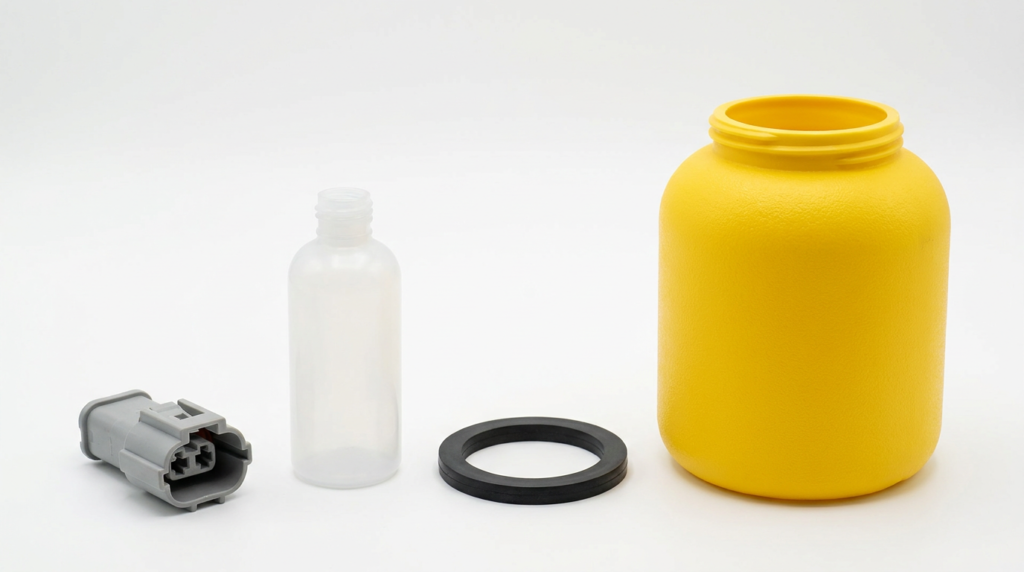
The four main types of plastic moulding are: (1) Injection moulding — molten plastic injected into a closed mold; (2) Blow moulding — air inflates a plastic tube inside a mold to create hollow shapes; (3) Compression moulding — material is compressed between two mold halves under heat and pressure; and (4) Rotational moulding — plastic powder is heated and rotated inside a mold to coat the interior. Each process suits different part geometries, materials, and production volumes.
Further Reading
For neutral technical background, see injection molding background.
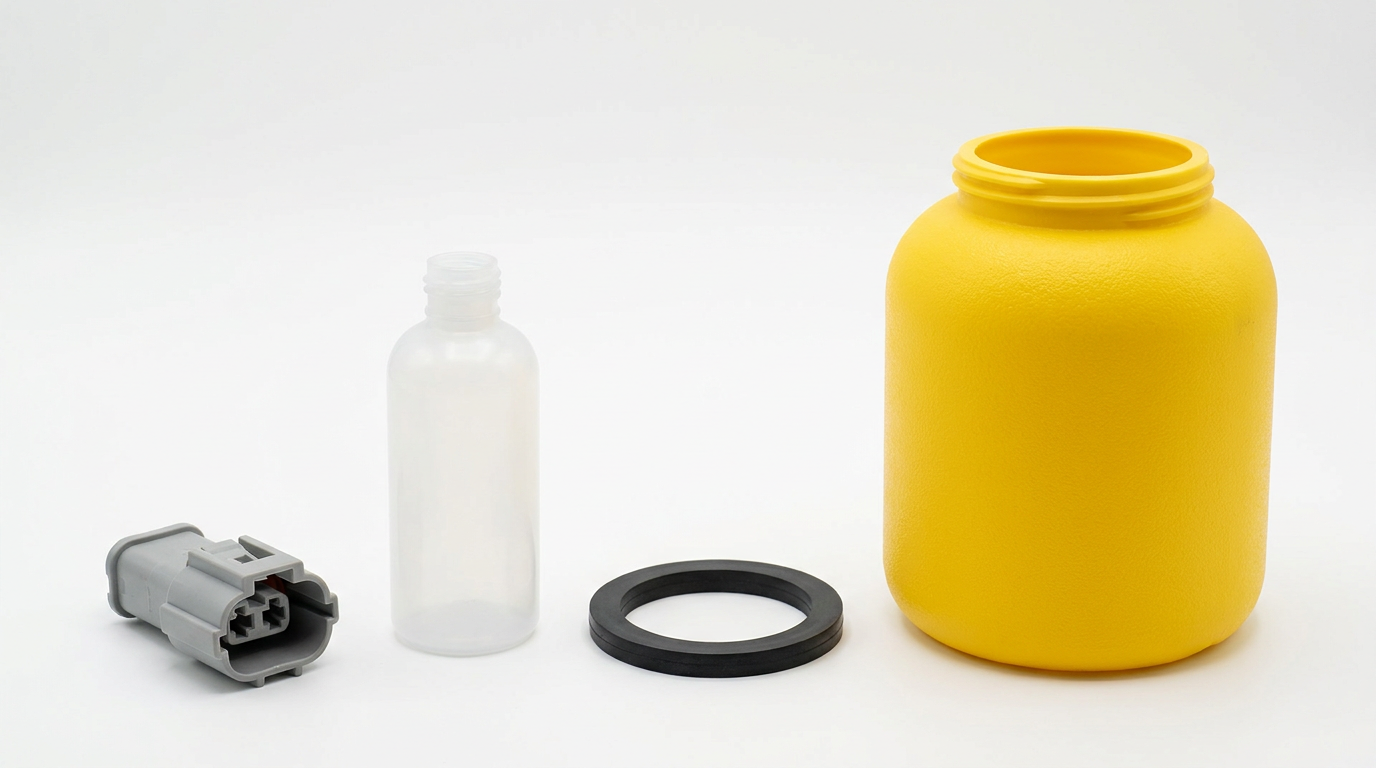
1. Injection Moulding
Injection moulding is by far the most common plastic manufacturing process. Molten thermoplastic is injected under high pressure (500–2,000 bar) into a precision steel mold cavity, where it cools and solidifies into the finished part shape.
- How it works: Plastic pellets → melted in barrel → injected into closed mold → cooled → ejected
- Typical cycle time: 10–60 seconds
- Part complexity: Very high — undercuts, threads, thin walls, complex 3D geometry
- Materials: All thermoplastics (PP, ABS, PC, PA, POM, PEEK, etc.)
- Tooling cost: High (\,000–\,000+)
- Best for: High-volume production of complex, precise parts
- Typical products: Automotive parts, electronic housings, medical devices, consumer products
2. Blow Moulding
Blow moulding creates hollow plastic parts by inflating a heated plastic tube (parison) or preform inside a mold using compressed air. The plastic expands to fill the mold cavity, creating a thin-walled hollow shape.
- How it works: Plastic parison/preform → heated → placed in mold → air inflated to fill mold → cooled → ejected
- Three variants: Extrusion blow moulding (EBM), Injection blow moulding (IBM), Injection stretch blow moulding (ISBM/PET bottles)
- Part complexity: Limited to hollow shapes; cannot produce solid parts
- Materials: PE (HDPE, LDPE), PP, PET, PVC
- Tooling cost: Medium (\,000–\,000)
- Best for: Hollow containers, bottles, tanks
- Typical products: Water bottles, detergent containers, fuel tanks, milk jugs
3. Compression Moulding
Compression moulding places a pre-measured amount of material (charge) between two heated mold halves. The mold closes under hydraulic pressure, forcing the material to flow and fill the cavity. Used primarily for thermosets and rubber.
- How it works: Material charge placed in open mold → mold closes under pressure and heat → material cures/crosslinks → mold opens → part removed
- Key difference: Material does not flow through runners like injection moulding — it is already in the cavity before the mold closes
- Materials: Thermosets (phenolic, epoxy, BMC, SMC), rubber, composites, and some thermoplastics
- Tooling cost: Low to medium (\,000–\,000)
- Best for: Large flat or moderately complex parts; thermoset and rubber parts
- Typical products: Rubber gaskets and seals, electrical switchgear housings, automotive SMC body panels, dinner plates
4. Rotational Moulding (Rotomoulding)
Rotational moulding (rotomoulding) loads plastic powder into a hollow mold, then heats and slowly rotates the mold on two perpendicular axes. The powder melts and coats the interior of the mold evenly, creating a seamless hollow part with uniform wall thickness.
- How it works: Plastic powder loaded into mold → mold heated while rotating on two axes → powder melts and coats interior → mold cooled while rotating → part removed
- Part size: Can produce very large parts (up to 10,000 litres) that would be impossible with injection moulding
- Wall thickness: Very uniform, stress-free walls — no injection pressure means no residual stress
- Materials: Primarily polyethylene (HDPE, LLDPE, XLPE), also PVC plastisol
- Tooling cost: Very low (\,000–\,000) — molds are typically aluminium
- Best for: Large hollow parts, low to medium volume
- Typical products: Water storage tanks, kayaks, playground equipment, agricultural tanks, road barriers
Side-by-Side Comparison: All 4 Types
| Feature | Injection | Blow | Compression | Rotational |
|---|---|---|---|---|
| Part geometry | Complex solid | Hollow only | Flat/moderate | Large hollow |
| Wall thickness | Varies | Thin | Moderate | Very uniform |
| Typical materials | Thermoplastics | PE, PP, PET | Thermosets, rubber | PE |
| Production speed | Fast (10–60s) | Medium | Slow (2–5 min) | Very slow (20–45 min) |
| Tooling cost | High | Medium | Low–medium | Very low |
| Part cost at volume | Very low | Low | Medium | Medium–high |
| Best volume | 100,000+ | 10,000+ | 1,000+ | 100–10,000 |
| Typical part size | Small–medium | Small–medium | Medium–large | Large–very large |
Which Moulding Process Is Right for Your Part?
Use this simple decision guide:
- Complex shape, high volume, tight tolerances → Injection moulding
- Hollow container or bottle → Blow moulding
- Rubber, thermoset, or large flat part → Compression moulding
- Very large hollow part, low volume → Rotational moulding
Frequently Asked Questions
What is the most common type of moulding?
Injection moulding is by far the most common plastic manufacturing process, accounting for roughly one-third of all plastic parts produced globally. Its combination of speed, precision, and design freedom makes it the default choice for most plastic components.
What is the difference between moulding and molding?
Moulding (with a u) is the British English spelling; molding is the American English spelling. Both refer to the same manufacturing processes. In international manufacturing contexts, both spellings are used interchangeably.
What are the 4 stages of injection moulding?
The four stages of injection moulding are: (1) Injection — molten plastic fills the cavity; (2) Packing — additional pressure compensates for shrinkage; (3) Cooling — the part solidifies; (4) Ejection — the finished part is pushed out of the mold.
Can you injection mould thermosets?
Standard thermoplastic injection moulding cannot process thermosets, as thermosets cure irreversibly under heat. However, specialized processes such as reaction injection moulding (RIM) and transfer moulding can process thermoset materials in a mold.
What type of moulding is used for car bumpers?
Car bumpers are typically made by injection moulding using TPO (thermoplastic polyolefin) or PP-EPDM blends. Large bumper moulds are among the largest injection tools, with clamping forces of 2,000–5,000 tonnes.
🔗 Related Articles
Need an Injection Mould?
BuildMold specialises in precision plastic injection moulds for automotive, medical, electronics, and industrial applications. Free DFM review and quotation within 24 hours.