
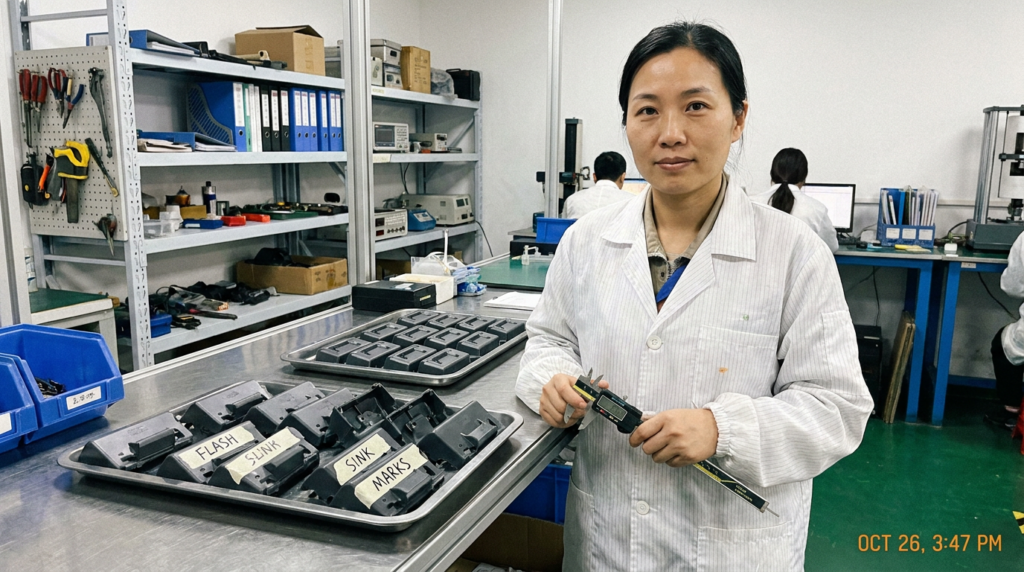
Even with well-designed parts, quality tooling, and experienced operators, injection molding presents a range of technical and operational challenges. Understanding the problems with injection molding — both process defects and broader operational issues — is essential for engineers, quality managers, and buyers who want to anticipate, prevent, and resolve the most common failures in production.
Further Reading
For neutral technical background, see injection molding background.
This guide covers the two categories of injection molding problems: part quality defects (visible in the finished part) and operational challenges (affecting process efficiency, cost, and supply chain).
Part Quality Problems (Defects)
1. Sink Marks
What it looks like: Shallow depressions or dimples on the surface of the part, typically above thick sections, ribs, or bosses on the opposite face.
Root causes:
- Insufficient hold pressure — plastic shrinks inward as it cools without enough packing to compensate
- Hold time too short — gate freezes off before adequate packing
- Wall thickness too great — excessive shrinkage in thick sections
- Rib or boss thickness too high relative to wall (should be ≤60% of wall thickness)
Solutions: Increase hold pressure and hold time; conduct gate freeze study; redesign ribs to 50–60% wall thickness; add cooling to thick sections.
2. Warping and Distortion
What it looks like: Part is bent, twisted, or bowed after ejection — does not match the intended flat or symmetric geometry.
Root causes:
- Uneven cooling between A-side and B-side of the mold
- Differential shrinkage from non-uniform wall thickness
- Over-packing creating residual stress that relaxes after ejection
- Fiber orientation effects in glass-filled materials
Solutions: Balance cooling channels; optimize hold pressure; redesign for uniform walls; use mold flow analysis to predict and reposition weld lines and fiber orientation.
3. Flash
What it looks like: Thin fins or membranes of plastic at the parting line, vents, or around ejector pins.
Root causes:
- Insufficient clamp force — injection pressure exceeds clamp force, forcing mold halves apart
- Worn or damaged parting surface — gaps allow melt to escape
- Injection pressure too high
- Mold misalignment
Solutions: Increase clamp force; reduce injection pressure; repair parting surface; check mold alignment and guide pin condition.
4. Short Shots (Incomplete Fill)
What it looks like: Part is incomplete — missing sections, typically at thin areas or far ends of the cavity.
Root causes:
- Insufficient injection pressure or speed
- Melt temperature too low — high viscosity resists flow
- Gate too small or blocked
- Inadequate venting — trapped air prevents fill
Solutions: Increase melt temperature, injection pressure, and speed; enlarge or clean gate; add venting at last-to-fill locations; check for blocked hot runner tips.
5. Weld Lines (Knit Lines)
What it looks like: Visible seam lines on the part surface where two flow fronts met during filling.
Root causes: Multiple gates or flow around holes/inserts causing converging flow fronts that fail to fully bond.
Solutions: Reposition gates to move weld lines to non-cosmetic areas; increase melt temperature to improve bonding at weld; increase injection speed; add overflow wells at weld line locations.
6. Burn Marks
What it looks like: Brown or black discoloration, typically at the end of fill or in thin sections.
Root causes:
- Trapped air compressed and heated by advancing melt front (diesel effect)
- Injection speed too high generating excessive shear heat
- Material residence time too long causing thermal degradation in barrel
Solutions: Add or clean vents at last-to-fill areas; reduce injection speed; reduce barrel temperature; increase shot size to reduce residence time.
7. Silver Streaks (Splay)
What it looks like: Silver or metallic streaks on the part surface, aligned with flow direction.
Root causes:
- Moisture in the material — steam generated during injection marks the surface
- Material degradation releasing volatile gases
- Contamination in the barrel or material
Solutions: Dry material to specification before processing (most hygroscopic resins require 2–4 hours at 80–120°C); purge barrel; check material for contamination.
8. Jetting
What it looks like: Snake-like or worm-track surface defect, starting from the gate location.
Root causes: High injection speed through a small gate into open cavity — melt jets without contacting cavity wall, then folds back on itself.
Solutions: Reposition gate to aim at a wall or core; enlarge gate; reduce initial injection speed (gate seal velocity profile).
9. Voids (Internal Bubbles)
What it looks like: Internal vacuum voids visible in transparent parts or detected by CT scan in opaque parts.
Root causes: Insufficient packing pressure in thick sections — skin freezes before core, and shrinking core pulls away from the skin creating a vacuum void.
Solutions: Increase hold pressure and time; redesign thick sections (core out to reduce wall thickness); improve gate location to reduce flow length to thick areas.
Operational Problems
10. High Tooling Cost and Long Lead Time
The most significant operational challenge — a production steel mold costs $5,000–$150,000+ and takes 4–16 weeks to manufacture. This creates:
- High capital risk before market validation
- Long time-to-market relative to 3D printing alternatives
- Reluctance to iterate design once tooling is committed
11. Mold Maintenance and Downtime
Molds require regular preventive maintenance to sustain part quality and prevent unplanned downtime:
- Cavity cleaning and polishing (every 50,000–200,000 shots)
- Cooling circuit flushing (scale and biological buildup reduce cooling efficiency)
- Ejector pin lubrication and replacement
- Hot runner tip cleaning and heater replacement
Deferred maintenance leads to progressive quality degradation and eventually catastrophic mold failure.
12. Material Management Complexity
Processing the wrong material grade, improperly dried resin, or contaminated regrind causes defects that can take hours to diagnose and correct. Strict material identification, drying protocol enforcement, and regrind management systems are essential in multi-material facilities.
13. Process Sensitivity to Environmental Conditions
Injection molding process parameters must be actively managed as ambient conditions change — seasonal temperature swings affect cooling water temperature, humidity affects hygroscopic materials, and shift changes introduce operator variability. SPC (Statistical Process Control) and automated process monitoring are essential for maintaining consistency.
Frequently Asked Questions
What are the most common problems with injection molding?
The most common part quality defects are sink marks, warping, flash, short shots, and weld lines. The most significant operational problems are high tooling cost, long lead times, expensive design changes after tooling, and mold maintenance requirements. Most defects have identifiable root causes and systematic solutions.
How do you prevent sink marks in injection molding?
Prevent sink marks by: increasing hold pressure and hold time (conduct a gate freeze study to find the minimum required hold time); designing ribs and bosses to 50–60% of adjacent wall thickness; coring out thick sections to reduce wall mass; and optimizing gate location to ensure adequate pressure transmission to thick areas.
What causes warping in injection molded parts?
Warping is caused by differential shrinkage — typically from uneven cooling (one side of the part cools faster than the other), non-uniform wall thickness, over-packing creating residual stress, or fiber orientation in glass-filled materials. It is addressed through balanced cooling channel design, uniform wall thickness, optimized hold pressure, and mold flow simulation.
How do you fix flash in injection molding?
Fix flash by: increasing clamp force (ensure it exceeds the product of cavity pressure × projected area); reducing injection or hold pressure; repairing worn parting line surfaces (re-machining or welding and re-grinding); checking mold alignment; and reducing mold temperature if thermal expansion is opening gaps at operating temperature.
What is the most difficult defect to eliminate in injection molding?
Warping in large, thin, flat parts is generally considered the most difficult defect to eliminate because it results from multiple interacting causes (differential cooling, fiber orientation, residual stress) that are difficult to fully control simultaneously. It typically requires a combination of mold redesign, material change, process optimization, and post-mold fixturing.
Summary
The problems with injection molding fall into two categories: part quality defects (sink marks, warping, flash, short shots, weld lines, burn marks, splay, jetting, and voids) and operational challenges (high tooling cost, maintenance requirements, material management, and process sensitivity). Most defects have well-understood root causes and systematic solutions rooted in part design, mold design, material handling, and scientific process development. Understanding these problems — and how to prevent them — is the foundation of successful injection molding production.