
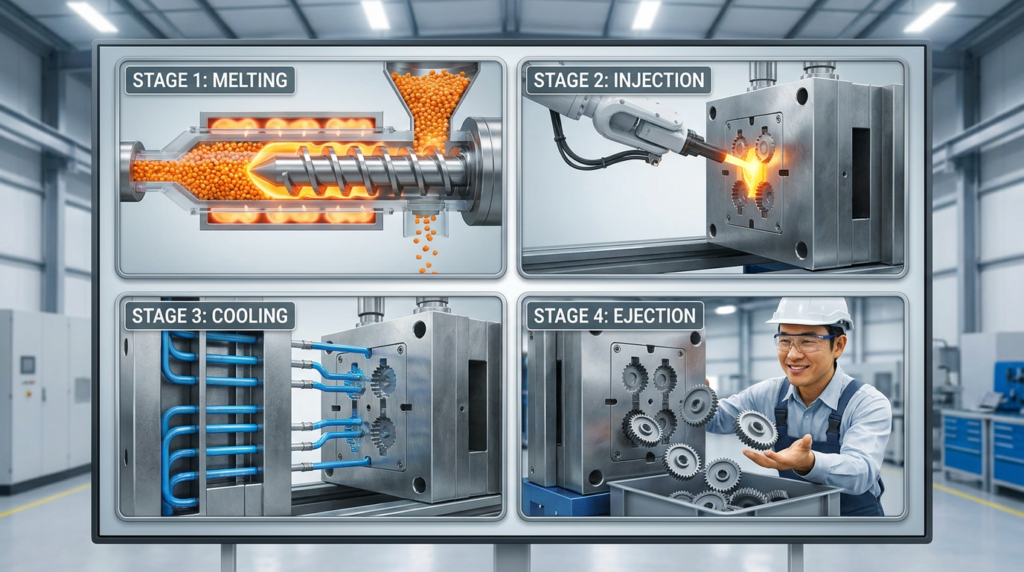
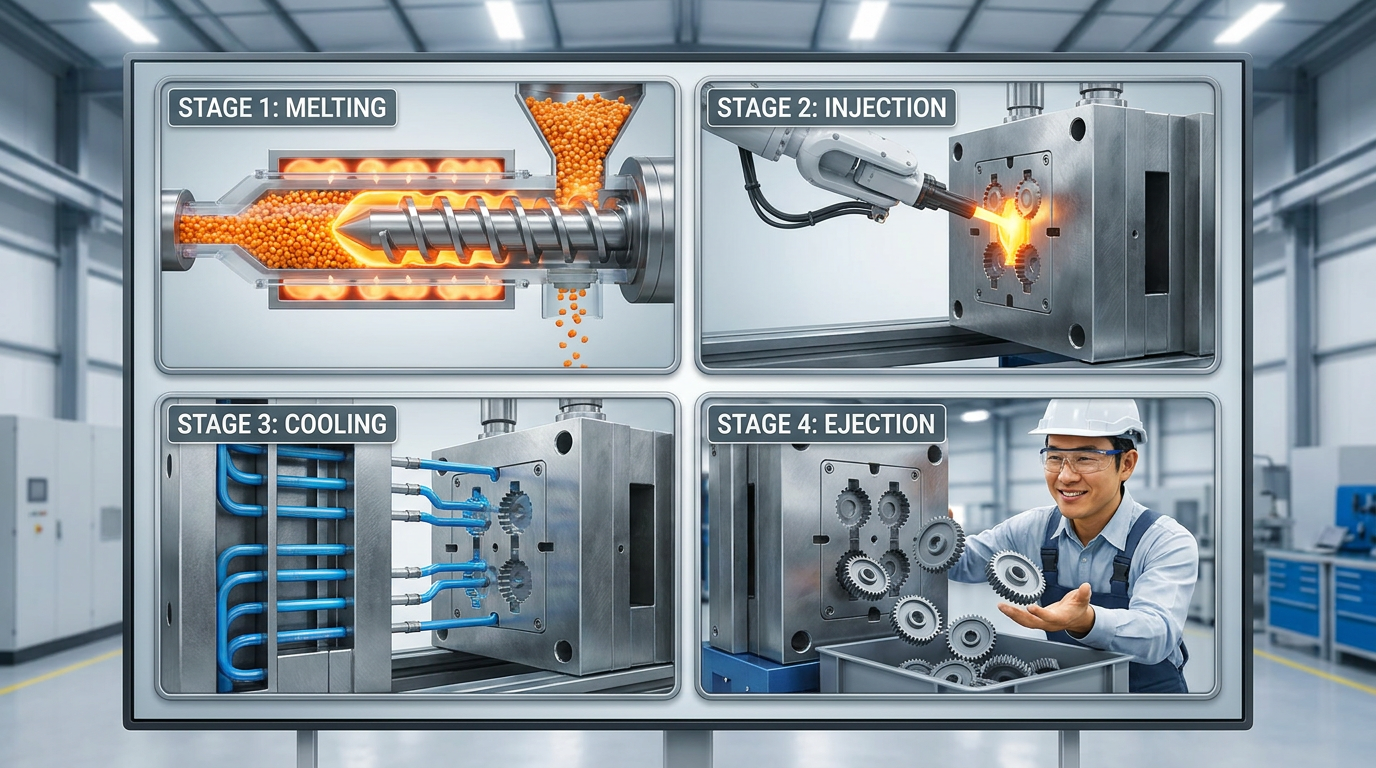
The four stages of injection molding are: (1) Injection — molten plastic is pushed into the closed mold cavity under high pressure; (2) Packing — additional pressure is applied to compensate for material shrinkage; (3) Cooling — the part solidifies as heat is removed through the mold; (4) Ejection — the mold opens and the finished part is pushed out by ejector pins. These four stages repeat every cycle, typically in 10–60 seconds.
Further Reading
For neutral technical background, see injection molding background.
Stage 1: Injection
The injection stage begins when the reciprocating screw moves forward, pushing molten plastic through the nozzle, into the sprue, along the runners, through the gates, and into the mold cavity.
- Injection speed: Typically 50–500mm/s screw velocity. Higher speed fills thin walls before freeze-off; lower speed reduces flash and shear heat
- Injection pressure: 500–2,000 bar at the screw tip. Pressure drops along the flow path; cavity pressure is lower than injection pressure
- Fill time: 0.5–5 seconds for most parts. Short fill times reduce cycle time; overly fast fill increases shear heating and potential flash
- Gate freeze: Injection stops when the cavity is ~95–98% full — just before the gate freezes off. Overfilling causes flash; underfilling causes short shots
- Key variables: Injection speed profile, peak injection pressure, transfer position (where injection transitions to packing)
Stage 2: Packing (Holding)
After the cavity is filled, the process transitions from injection to packing (also called the holding phase). The screw continues to apply lower, controlled pressure to compensate for volumetric shrinkage as the plastic cools and densifies.
- Pack pressure: Typically 50–80% of peak injection pressure, held for 2–15 seconds
- Pack time: Determined by gate freeze-off time — packing beyond gate freeze wastes energy without benefit. Gate freeze is confirmed by weighing parts at increasing pack times until weight stabilizes
- Effect of insufficient packing: Sink marks, internal voids, underweight parts, dimensional variation
- Effect of excessive packing: Overpacking near gate causes residual stress, flash, part sticking, and difficult ejection
- Key variables: Pack pressure level, pack time, transition point from injection to pack
Stage 3: Cooling
The cooling stage begins simultaneously with packing and continues after pack pressure is released. Cold water (or oil for high-temperature molds) circulates through channels in the mold, extracting heat from the part until it is rigid enough to be ejected without distortion.
- Cooling time: 60–70% of total cycle time. The dominant factor in cycle time optimization
- Mold temperature: 20–60°C for standard amorphous plastics; 60–120°C for semi-crystalline materials (PA, POM, PPS) that require controlled crystallization
- Coolant temperature: Typically 10–40°C water, controlled by a mold temperature controller (chiller or heater-chiller unit)
- Cooling channel design: Channels positioned 1.5× their diameter from the cavity surface. Conformal cooling (3D-printed channels) reduces cooling time by 20–40% in complex molds
- Ejection temperature: Part must cool below the material’s heat deflection temperature (HDT) before ejection. Ejecting too hot causes warpage and surface marks
Stage 4: Ejection
When the part has cooled sufficiently, the mold opens and the ejector system pushes the part out of the cavity. The mold then closes and the cycle repeats.
- Ejector pins: Most common ejection method. Hardened steel pins push against the part surface. Pin marks are visible on the ejected surface (B-side) and must be placed in non-cosmetic areas
- Ejection force: Determined by part geometry, draft angle, surface finish, and material. Insufficient draft or rough cavity surfaces increase sticking force
- Stripper plate: A plate that moves with the ejection stroke to push the part off the core. Used for thin-wall containers and parts where pin marks are unacceptable
- Air assist: Compressed air blown into the cavity helps release parts that would otherwise stick. Common for deep cores and low-draft surfaces
- Robot part removal: High-volume production uses robotic arms to remove parts, orient them, and place them on conveyors or into inspection stations
The Complete Injection Molding Cycle
| Stage | Typical Duration | Key Parameter | Effect on Part Quality |
|---|---|---|---|
| Mold closing | 1–3s | Clamp speed and force | Insufficient clamp = flash |
| Injection (Fill) | 0.5–5s | Injection speed and pressure | Affects fill balance, shear heat, weld lines |
| Packing (Hold) | 2–15s | Pack pressure and time | Affects sink marks, weight, dimensions |
| Cooling | 5–40s | Mold temp, coolant temp | Affects warpage, cycle time, surface quality |
| Mold opening | 1–3s | Opening speed | Too fast can drag part surface |
| Ejection | 0.5–2s | Ejector speed and stroke | Too fast causes part damage |
| Total cycle | 10–60s | All above | Determines productivity |
How to Reduce Cycle Time
Since cycle time directly determines parts-per-hour output, reducing it without sacrificing quality is a key optimization goal:
- Optimize cooling — Cooling time is 60–70% of cycle time. Improve cooling channel placement, lower coolant temperature, or use conformal cooling inserts
- Reduce pack time — Use gate freeze-off study to set the minimum effective pack time. Every unnecessary second of packing adds to cycle time
- Increase injection speed — Faster fill reduces injection stage time but must be balanced against shear heat and flash risk
- Reduce mold open/close time — Optimize machine motion profiles; use fast-open/slow-close to protect the mold
- Automate ejection — Robot part removal eliminates operator cycle time variability and enables faster mold open speeds
Frequently Asked Questions
What is the most important stage of injection molding?
Cooling is arguably the most important stage because it determines 60–70% of total cycle time and significantly affects part warpage and dimensional stability. However, the injection and packing stages have the greatest impact on part quality (filling defects, sink marks, dimensions).
What happens if you eject too early?
Ejecting before the part has cooled below its heat deflection temperature causes warpage, surface deformation (ejector pin push-through marks), and dimensional non-conformance. In severe cases, the part sticks to the mold or is visibly distorted when ejected.
What is the difference between injection and packing pressure?
Injection pressure is the high pressure (500–2,000 bar) used to fill the cavity rapidly. Packing (holding) pressure is the lower pressure (typically 50–80% of injection pressure) applied after filling to compensate for shrinkage. Using high injection pressure during packing causes overpacking defects.
Why does cooling take so long in injection molding?
Plastic is a poor thermal conductor — approximately 1,000× worse than steel. Heat must diffuse from the plastic through the steel mold wall to the coolant. Reducing wall thickness, improving cooling channel placement, and lowering coolant temperature all help reduce cooling time.
🔗 Related Articles
Need a Precision Injection Mold?
BuildMold engineers design molds optimized for short cycle times and consistent part quality. Free DFM review and quotation within 24 hours.