
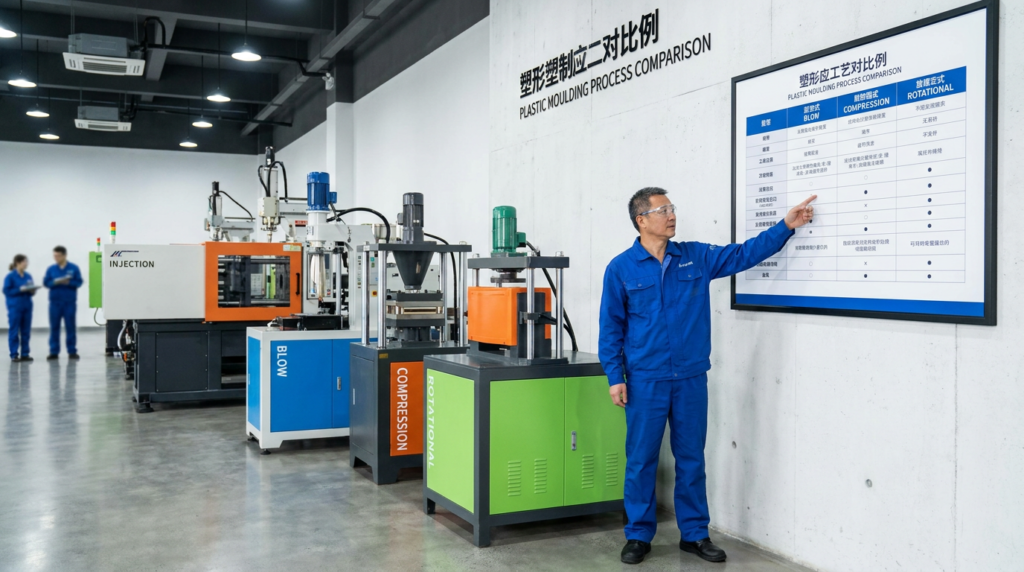
When engineers and product designers ask “what are the 4 types of moulding?”, they are typically referring to the four most widely used plastic moulding processes in industrial manufacturing: injection moulding, blow moulding, compression moulding, and rotational moulding. Each process has distinct characteristics, cost profiles, and ideal applications. Choosing the right moulding method is one of the most consequential decisions in product development.
Further Reading
For neutral technical background, see injection molding background.
This guide explains each of the four types in depth — covering how they work, what materials they use, typical applications, and when to choose one over another.
Overview: The 4 Types of Moulding at a Glance
| Moulding Type | Process Principle | Typical Materials | Best For | Tooling Cost |
|---|---|---|---|---|
| Injection Moulding | Molten plastic injected into a closed mould under pressure | ABS, PP, PC, Nylon, POM | High-volume precision parts | High ($5,000–$100,000+) |
| Blow Moulding | Air pressure inflates a molten parison inside a mould | HDPE, PET, PP, PVC | Hollow containers & bottles | Medium ($2,000–$20,000) |
| Compression Moulding | Material compressed between heated mould halves | Thermosets, rubber, BMC, SMC | Large flat/simple parts, thermosets | Low–Medium ($1,000–$15,000) |
| Rotational Moulding | Mould rotates biaxially while material coats interior walls | LLDPE, PVC plastisol, Nylon | Large hollow parts, low volume | Low ($500–$10,000) |
Type 1: Injection Moulding
How Does Injection Moulding Work?
Injection moulding is the most widely used plastic manufacturing process globally. Plastic pellets are fed into a heated barrel, melted by a rotating screw, and injected at high pressure (70–140 MPa) into a precision steel or aluminium mould. The part cools and solidifies in the mould, then is ejected. The entire cycle typically takes 10–60 seconds.
Key Characteristics
- Dimensional accuracy: Tolerances as tight as ±0.05 mm
- Surface finish: Excellent — SPI A1 to D3 finishes available
- Part complexity: Very high — undercuts, threads, living hinges, multi-material (overmoulding)
- Cycle time: Fast — 10 seconds to 2 minutes per cycle
- Volume: Economical at 1,000 to millions of parts
Typical Applications
- Consumer electronics housings (laptop shells, smartphone cases)
- Automotive interior components (dashboards, door panels, clips)
- Medical devices (syringes, inhaler bodies, surgical instrument handles)
- Packaging (caps, closures, thin-wall containers)
- Industrial components (gears, housings, connectors)
Advantages & Limitations
| Advantages | Limitations |
|---|---|
| Extremely high repeatability | High tooling cost ($5,000–$100,000+) |
| Wide material selection | Long lead time for mould fabrication (4–12 weeks) |
| Excellent surface finish | Not economical for very low volumes (<500 parts) |
| Fast cycle times at scale | Design changes require mould modification |
Type 2: Blow Moulding
How Does Blow Moulding Work?
Blow moulding produces hollow plastic parts — primarily bottles, containers, and tanks. A molten plastic tube (called a parison) is formed and clamped inside a mould. Compressed air is then blown into the parison, inflating it against the mould walls. The part cools and is ejected. There are three main variants:
- Extrusion Blow Moulding (EBM): Continuous parison extrusion; used for HDPE bottles, jerry cans
- Injection Blow Moulding (IBM): Parison is injection-moulded first, then blown; used for PET bottles with high accuracy
- Injection Stretch Blow Moulding (ISBM): Parison is both stretched and blown; used for PET beverage bottles with excellent clarity and strength
Key Characteristics
- Part geometry: Hollow, enclosed shapes only
- Wall thickness: Relatively uniform but not precisely controlled
- Volume: High-volume production (millions of units/year for bottles)
- Cycle time: 10–30 seconds for small bottles
Typical Applications
- PET beverage bottles (water, soft drinks, juice)
- HDPE containers (shampoo, detergent, motor oil)
- Industrial tanks (fuel tanks, chemical drums)
- Automotive ducts and reservoirs
Advantages & Limitations
| Advantages | Limitations |
|---|---|
| Ideal for hollow, seamless containers | Limited to hollow geometries |
| Lower tooling cost than injection moulding | Wall thickness less controllable than injection |
| Fast cycle times for bottles | Not suitable for complex external features |
| High volume efficiency | Trimming flash required (EBM) |
Type 3: Compression Moulding
How Does Compression Moulding Work?
Compression moulding is one of the oldest plastic forming processes, primarily used for thermoset materials (which cure irreversibly under heat and pressure). A pre-measured charge of material — typically a dough-like compound (BMC), sheet compound (SMC), or rubber — is placed directly into an open, heated mould cavity. The mould closes under hydraulic pressure (7–50 MPa), forcing the material to flow and fill the cavity. Heat triggers the chemical curing reaction, solidifying the part permanently.
Key Characteristics
- Materials: Thermosets (phenolic, epoxy, melamine, polyester BMC/SMC), rubber, PEEK composites
- Part size: Can produce very large, flat, or moderately complex parts
- Cycle time: Slower than injection moulding (1–5 minutes due to curing)
- Tooling: Simpler, lower-cost moulds than injection moulding
Typical Applications
- Electrical insulators and switch components (phenolic resin)
- Automotive body panels and structural parts (SMC/BMC)
- Rubber seals, gaskets, and O-rings
- Kitchenware (melamine plates and utensils)
- Aerospace composite components
Advantages & Limitations
| Advantages | Limitations |
|---|---|
| Excellent for thermoset and rubber materials | Slower cycle time than injection moulding |
| Low-to-medium tooling cost | Not suitable for thermoplastics (generally) |
| Good for large, flat parts | Manual material loading reduces consistency |
| Minimal material waste | Flash trimming often required |
Type 4: Rotational Moulding (Rotomoulding)
How Does Rotational Moulding Work?
Rotational moulding (rotomoulding) produces large, hollow, seamless parts with uniform wall thickness. Powdered plastic (typically LLDPE) is loaded into a closed mould, which is then heated in an oven while rotating simultaneously on two perpendicular axes. The melted plastic coats the interior walls evenly. The mould then moves to a cooling station, the plastic solidifies, and the part is demoulded.
Rotomoulding operates at low pressure (atmospheric), allowing inexpensive aluminium moulds. However, cycle times are long (20–45 minutes), making it unsuitable for high-volume production.
Key Characteristics
- Part size: Can produce very large parts (up to several cubic metres)
- Wall uniformity: Excellent — no weld lines or seams
- Tooling cost: Very low ($500–$10,000 for aluminium moulds)
- Cycle time: Long — 20–45 minutes per cycle
- Volume: Low to medium (100–10,000 parts/year)
Typical Applications
- Large water storage tanks (500L–20,000L)
- Kayaks, canoes, and playground equipment
- Agricultural chemical tanks
- Traffic barriers and road bollards
- Industrial bins and pallets
Advantages & Limitations
| Advantages | Limitations |
|---|---|
| Very low tooling cost | Very slow cycle time (20–45 min) |
| Seamless, stress-free hollow parts | Limited material options (mainly PE) |
| Can produce very large parts | Not suitable for tight tolerances |
| Low minimum order quantities | Higher per-part cost at volume vs injection |
How to Choose the Right Moulding Type for Your Project
Use this decision framework to select the appropriate moulding process:
| Requirement | Best Choice |
|---|---|
| High volume (>10,000 parts), tight tolerances, complex shape | Injection Moulding |
| Hollow container or bottle (any volume) | Blow Moulding |
| Thermoset material, large flat part, rubber part | Compression Moulding |
| Very large hollow part, low volume, low tooling budget | Rotational Moulding |
| Low volume prototype (<500 parts), complex geometry | 3D Printing or Urethane Casting |
Frequently Asked Questions
What are the 4 types of moulding?
The four main types of plastic moulding are injection moulding, blow moulding, compression moulding, and rotational moulding. Each uses a different process principle and is suited to different materials, part geometries, and production volumes.
Which type of moulding is most commonly used?
Injection moulding is by far the most widely used plastic moulding process, accounting for approximately one-third of all plastic parts produced globally. It offers the best combination of precision, speed, material versatility, and scalability for high-volume production.
What is the difference between injection moulding and blow moulding?
Injection moulding produces solid or hollow-walled parts with high dimensional precision by injecting molten plastic into a closed mould. Blow moulding produces hollow, thin-walled containers by inflating a molten parison with air. The two processes serve completely different geometries and are rarely interchangeable.
Is compression moulding the same as injection moulding?
No. Compression moulding places material directly into an open mould and uses heat and pressure to cure it — primarily for thermosets and rubber. Injection moulding injects molten thermoplastic under high pressure into a closed mould. Injection moulding is faster and more repeatable; compression moulding handles materials that cannot be processed in an injection machine.
What is rotational moulding used for?
Rotational moulding is used primarily for large, hollow, seamless parts — such as water tanks, kayaks, playground equipment, and road barriers — that are too large or complex for blow moulding and too costly to produce by injection moulding at low volumes.
Can you use injection moulding for thermoset materials?
Yes — thermoset injection moulding (also called reaction injection moulding, or RIM, for certain materials) is possible using specialized equipment. However, compression moulding remains more common for thermosets due to lower tooling cost and simpler process requirements.
Summary
The four types of moulding — injection, blow, compression, and rotational — cover the vast majority of plastic and rubber part manufacturing needs worldwide. Injection moulding dominates for precision, high-volume thermoplastic parts. Blow moulding is the standard for hollow containers. Compression moulding serves thermosets and rubber. Rotational moulding is the go-to for large hollow parts at low volumes.
Selecting the right process from the outset saves time, tooling investment, and per-part cost across the product’s lifetime. When in doubt, consult a mould maker with DFM (Design for Manufacturability) expertise to evaluate your specific geometry, material, and volume requirements.